For most New Zealand renovation projects, thermally broken aluminium is the best all-round choice. uPVC leads on insulation and upfront cost in cold, energy-focused builds where slim sightlines are not a priority. Standard aluminium without a thermal break is rarely the right call for a new installation.
The core trade-off is straightforward. uPVC offers better thermal performance by default and typically costs less per square metre, but its thicker profiles and limited colour range suit some homes better than others. Thermally broken aluminium costs more upfront, delivers slim modern frames, and handles coastal salt air and UV exposure better when correctly specified. BRANZ notes that the framing material is as important as the glazing itself, and that a poorly specified aluminium window can perform worse than a single-glazed timber window.
Choose uPVC when:
- Your priority is maximum thermal insulation at a lower upfront cost
- The home is inland, away from coastal salt-air exposure
- You are retrofitting an older home where energy performance outweighs aesthetics
- Noise reduction is a key requirement
Choose thermally broken aluminium when:
- The design calls for slim sightlines, large sliders, or a contemporary look
- The property is within 500 metres of the coast or in a high-corrosion zone
- You want a 40-plus-year lifespan with minimal structural maintenance
- The project is a new build or full renovation where architectural flexibility matters
Avoid standard aluminium (no thermal break) for any climate-controlled living space. It sits at the bottom of the thermal performance scale and will not meet NZ Building Code H1 energy-efficiency requirements in most configurations without compensating elsewhere in the glazing specification.
Both materials are available through New Zealand suppliers, and Sortedhomesolutions manages window selection and installation as part of full Auckland renovation projects, including product spec checks and WEERS compliance.
Table of Contents
- How do uPVC and aluminium windows compare head to head?
- Does thermally broken aluminium actually perform as well as uPVC?
- What does uPVC vs aluminium actually cost in New Zealand?
- How long do uPVC and aluminium windows last in NZ conditions?
- Which frame material suits the look of your home?
- What do you need to specify for coastal or high-UV sites?
- How do you choose the right window material for your project?
- How Sortedhomesolutions approaches window choices on Auckland projects
- Key takeaways
- The spec matters more than the material
- Sortedhomesolutions handles your window project from spec to sign-off
- Sources and further reading
How do uPVC and aluminium windows compare head to head?
The table below covers the dimensions that matter most when you are comparing quotes and deciding which frame material suits your project.
| Dimension | uPVC | Standard aluminium | Thermally broken aluminium |
|---|---|---|---|
| Best for | Energy-focused retrofits, cold climates, noise reduction | Budget replacements where thermal performance is not critical | Modern builds, coastal sites, large openings |
| Typical cost (NZ, quality double-glazed) | ~$700–$1,200/m² | — | ~$800–$1,500/m² |
| Thermal performance | High (multi-chamber profile) | Low (R ≈ 0.26 m²K/W double-glazed) | Moderate to high (R ≈ 0.8 m²K/W) |
| Lifespan | Multiple decades with proper UV stabilisation | 40+ years (frame); finish may degrade sooner | Multiple decades with quality powder coat |
| Maintenance | Low; wipe clean, no painting | Low frame; powder coat may need inspection | Low; inspect seals and hardware annually |
| Profile width | Thicker; less glass area | Slim | Slim; similar to standard aluminium |
| Colour options | Limited; foils available | Broad powder-coat range | Broad powder-coat and anodised range |
| Coastal suitability | Moderate (UV stabilisation required) | Poor without marine-grade finish | Good with marine-grade powder coat. |
| Warranty (typical) | 10–15 years frame; 5–10 years IGU | 10–15 years frame; 5–10 years IGU | 10–15 years frame; 5–10 years IGU |
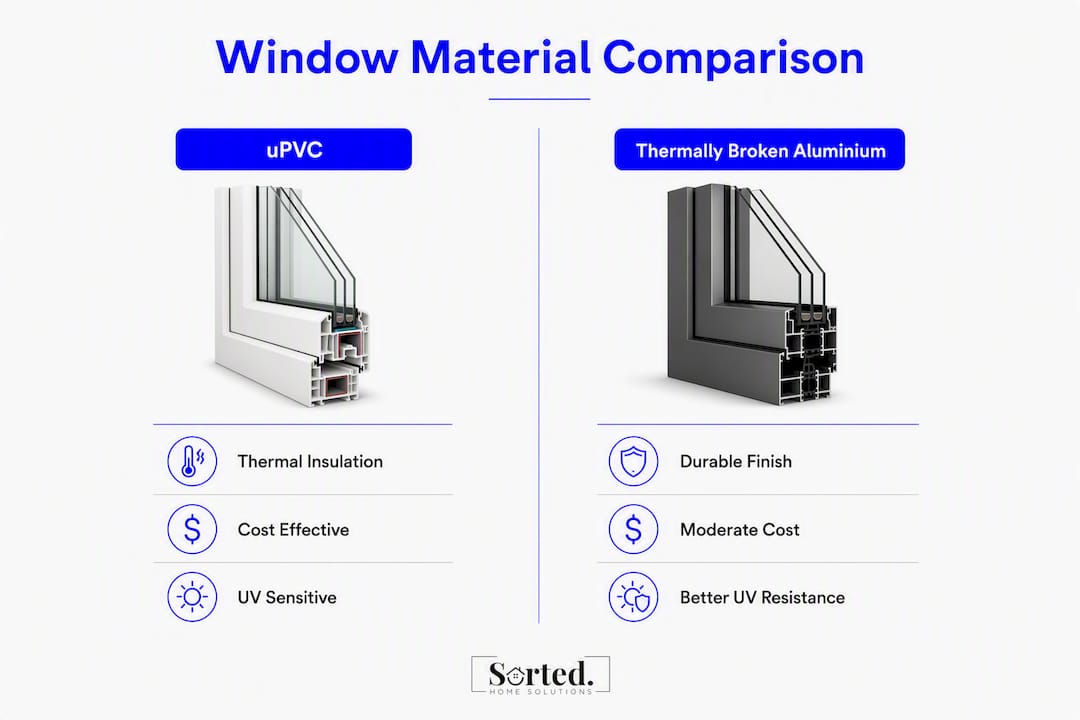
A few points worth calling out. Thermally broken aluminium is the standard choice for modern NZ builds because it balances slim profiles with reasonable thermal performance. uPVC, timber, and fibreglass all outperform standard aluminium thermally, so if a supplier is quoting standard aluminium for a new living area, ask specifically why a thermal break is not included.
For uPVC vs aluminium doors, the same principles apply. uPVC door frames deliver better insulation; aluminium handles larger spans and heavier sliding door configurations more reliably.
Does thermally broken aluminium actually perform as well as uPVC?
Not quite, but it comes close enough for most NZ projects when correctly specified.
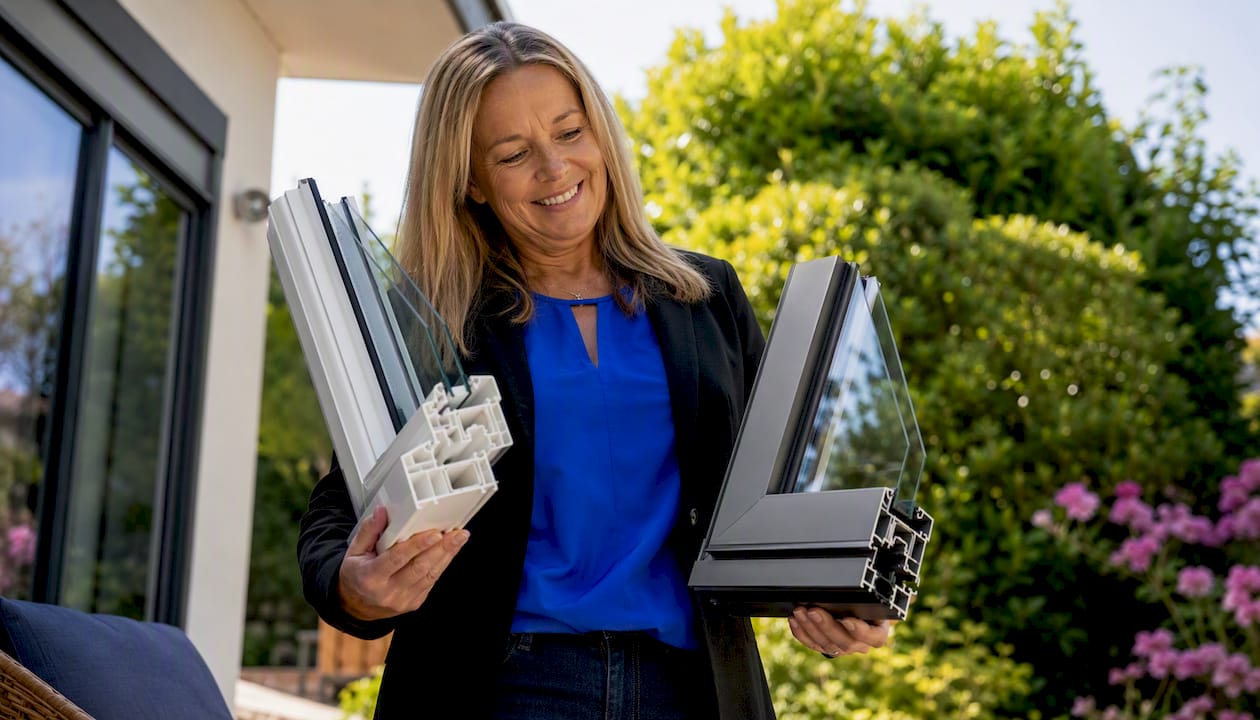
uPVC profiles use a multi-chamber construction that inherently resists heat transfer. Aluminium conducts heat readily, which is why a thermal break, a low-conductivity polyamide strip inserted between the inner and outer aluminium sections, is necessary to interrupt that path. According to Level.org.nz testing, thermally broken aluminium frames can be almost 60% more thermally efficient than standard aluminium frames.
The R-value numbers make the difference concrete. Windows & Glass NZ reports the following representative figures for double-glazed systems:
| Frame type | Glazing | Approximate R-value (m²K/W) |
|---|---|---|
| Standard aluminium | Double-glazed | R ≈ 0.26 |
| Thermally broken aluminium | Double-glazed | R ≈ 0.80 |
| Thermally broken aluminium | Triple-glazed | R ≈ 1.00 |
| uPVC | Double-glazed | Higher than standard aluminium; comparable to thermally broken when well specified |
One important caveat: these R-values are calculated for a standard test size of 1.8 m × 1.5 m. Smaller windows have a higher frame-to-glass ratio, which can make an otherwise better-performing system deliver worse real-world results. This is why BRANZ and Level both recommend using the Window Energy Efficiency Rating System (WEERS) rather than relying on frame material alone. WEERS accounts for the actual IGU specification, frame type, and your project window sizes, and it ties directly into NZ Building Code H1 compliance checks.
Pro Tip: When requesting quotes, ask each supplier for a WEERS report for your specific window sizes, not just a generic R-value for the product range. Also confirm the IGU specification: glass thickness, spacer type (warm-edge spacers outperform aluminium bars), argon gas fill, and low-E coating. These details shift performance significantly.
For energy efficiency improvements in NZ homes, windows are one of the highest-impact upgrades. Getting the specification right at the quote stage is far cheaper than retrofitting later.
What does uPVC vs aluminium actually cost in New Zealand?
Cost is where uPVC holds a clear advantage for budget-conscious projects. Quality uPVC double-glazed windows typically run around $700–$1,200 per m² in New Zealand, while thermally broken aluminium sits at roughly $800–$1,500 per m² for quality systems. Budget aluminium without a thermal break is generally the least expensive option available, though that saving is largely offset by higher energy costs and the likelihood of condensation issues.
These are supply-and-install ballpark figures. The final number moves depending on:
- Opening size: Larger sashes cost more per unit but less per m²
- Thermal break specification: A higher-grade polyamide strip adds cost but improves performance
- Triple glazing: Adds roughly 20–30% to the glazing cost over double-glazed
- Bespoke colours: Non-standard powder-coat colours carry a surcharge, typically 10–15%
- Marine-grade finish: Required for coastal sites; adds cost to aluminium
- Steel stiffeners in uPVC: Necessary for larger spans; confirm these are included in the quote
Lifecycle cost tells a different story from upfront price. A well-specified thermally broken aluminium window with quality powder coat can last multiple decades with minimal structural maintenance. uPVC with proper UV stabilisation typically delivers a lifespan considered adequate for typical home use. The IGU (double-glazed unit) inside either frame usually carries a 5–10 year warranty and may need replacement before the frame itself.
When comparing quotes, check for these hidden costs:
- Site repairs to surrounding linings, plaster, or weatherboards after frame removal
- Flashings and sill trays (sometimes excluded from joinery-only quotes)
- Joinery labour vs supply-only pricing
- Warranty exclusions for condensation or finish failure
- Whether the quote includes building consent if required
For context on how window costs fit within a broader renovation budget, the Sortedhomesolutions renovation pricing guide covers fixed-fee project structures for Auckland homeowners.
How long do uPVC and aluminium windows last in NZ conditions?
Both materials are durable, but the conditions they face in New Zealand, particularly UV intensity and coastal salt air, affect how long they perform without intervention.
Aluminium frames, when powder-coated to a quality standard, can last multiple decades. The frame itself does not corrode in the way steel does, but the powder-coat finish can chalk, fade, or blister if the coating specification is inadequate for the exposure zone. For coastal sites, a marine-grade powder coat or anodised finish is the minimum acceptable spec. NZ Building Code Clause B2 requires window materials to demonstrate expected durability of at least 15 years, but quality aluminium systems significantly exceed that threshold when correctly specified and installed.
uPVC performs well structurally but has a specific vulnerability in New Zealand: UV radiation. Without UV stabilisation, typically achieved through titanium dioxide additives in the compound, uPVC profiles can become brittle and discolour prematurely under NZ's high-intensity UV. Always confirm in writing that any uPVC product is UV-stabilised for NZ conditions. Cheap imported profiles often omit this.
For larger uPVC windows and doors, steel reinforcement inside the profiles is required to meet wind load requirements and prevent sagging over time. This is a non-negotiable spec item for spans wider than roughly 1.2 metres.
Maintenance and warranty checklist:
- Clean frames twice yearly with mild detergent; avoid abrasive cleaners on powder coat
- Inspect and lubricate hardware (hinges, locks, stays) annually
- Check drainage slots in the sill are clear; blocked drainage causes water ingress
- Inspect seals and gaskets every two to three years; replace if cracked or compressed
- Confirm the written warranty covers: frame finish, hardware, IGU seal failure, and workmanship
- Ask whether the warranty is backed by the manufacturer, the installer, or both
When deciding whether to repair or replace windows, the condition of the IGU seal is often the deciding factor. A failed seal causes fogging between panes and cannot be fixed without replacing the unit.
Pro Tip: Ask your supplier for the powder-coat specification by brand and micron thickness. A quality exterior powder coat for NZ conditions should meet AS/NZS 4506 or equivalent and be applied at a minimum of 60 microns. Thinner coatings degrade faster, particularly in coastal zones.
Which frame material suits the look of your home?
Aluminium's main aesthetic advantage is its slim profile. Because aluminium is structurally stronger than uPVC at equivalent section sizes, manufacturers can produce narrower frames that maximise glass area. For large sliding doors, bi-fold systems, or floor-to-ceiling glazing, aluminium is the practical choice. uPVC profiles are noticeably wider, which reduces the visible glass area and can look heavy on contemporary designs.
Finish options differ meaningfully between the two materials:
- Aluminium accepts powder coat in virtually any colour, including custom RAL shades, and can be anodised for a metallic finish. The colour range is broad and the finish is durable when correctly applied.
- uPVC is available in white, grey, and a limited range of foil-wrapped finishes that simulate timber or dark colours. The foils can fade or peel in NZ's UV conditions if the product is not specifically rated for outdoor use.
Matching material to architectural style:
- Contemporary new build or modern renovation: Thermally broken aluminium, slim profile, dark powder coat (Ironsand or Titania are common NZ choices)
- 1950s–1970s bungalow or villa retrofit: uPVC in white or light grey suits the proportions and delivers better insulation; older homes often have specific retrofit challenges that affect frame selection
- Large sliders or bi-fold openings: Aluminium only; uPVC cannot reliably handle the span and weight
- Heritage or character home: Timber remains the most sympathetic choice, but thermally broken aluminium in a heritage profile can work where timber maintenance is a concern
What do you need to specify for coastal or high-UV sites?
Coastal exposure is one of the most common causes of premature window failure in New Zealand. Salt-laden air accelerates corrosion of inadequate coatings and degrades poorly stabilised uPVC. The specification requirements are different from an inland site, and the cost difference is worth paying.
For aluminium within 500 metres of the coast:
- Specify marine-grade powder coat or anodising; confirm the coating meets the supplier's own coastal warranty terms
- Use stainless steel fixings throughout; standard zinc-plated fixings corrode within a few years in salt air
- Confirm drainage details include adequate weep holes and that sill trays are stainless or powder-coated aluminium
- Ask about sacrificial trim options at sill level where water pooling is likely
- Inspect annually in the first two years to catch any finish failure early
For uPVC in high-UV or coastal-adjacent sites:
- Confirm UV stabilisation is included in the compound, not just a surface treatment
- Avoid dark foil finishes in high-UV locations; they absorb more heat and can cause the foil to delaminate
- Check that any steel reinforcement inside the profiles is galvanised or stainless to prevent rust staining through the profile
NZ Building Code Clause B2 sets a minimum 15-year durability benchmark, but coastal exposures often require upgraded specifications to meet that threshold reliably. A supplier who cannot provide a written coastal warranty for their product is a red flag.
Cheap imported windows, whether uPVC or aluminium, frequently lack adequate UV stabilisation or coastal-grade coatings. The price difference between a quality NZ-stocked product and a budget import is small relative to the cost of replacing failed windows within a decade.
How do you choose the right window material for your project?
Work through these steps before contacting suppliers. The order reflects priority: thermal performance and durability first, then aesthetics and budget.
- Confirm your climate zone and H1 requirements. Check which NZ Building Code H1 climate zone your property sits in. Higher zones require better-performing windows. Your building consent application will need to demonstrate compliance, and WEERS is the most straightforward way to do that.
- Assess your exposure zone. Is the property within 500 metres of the coast, or in a high-UV inland location? This determines whether marine-grade specs are required and whether uPVC UV stabilisation is a non-negotiable.
- Define your thermal priority. If energy bills and warmth are the primary drivers, uPVC or thermally broken aluminium with a quality IGU will both perform well. If you are in a mild climate and aesthetics matter more, thermally broken aluminium is the practical choice.
- Set a realistic budget. Use the $700–$1,500/m² range as a starting point and add 15–20% for site repairs, flashings, and installation variables.
- Request WEERS documentation from every supplier. Do not accept a generic R-value for the product range. Ask for WEERS figures for your actual window sizes.
Questions to ask every supplier:
- What is the WEERS rating for this product at my window sizes?
- Does the aluminium frame include a thermal break, and what is the polyamide specification?
- What spacer type is used in the IGU, and is low-E glass included?
- For uPVC: are steel stiffeners included in the profiles for spans over 1.2 metres?
- What is the powder-coat specification (brand, micron thickness, coastal rating)?
- Who backs the workmanship warranty, and for how long?
Red flags to reject a quote:
- No WEERS data or thermal performance documentation
- Missing drainage detail or no mention of sill trays
- Unspecified or generic coating descriptions
- No local installer or workmanship warranty
- No product spec sheet or compliance documentation
What to insist on in the contract:
- Full product spec sheet attached to the quote
- Scope of works including site protection, removal of existing frames, and reinstatement of linings
- Lead times confirmed in writing
- Written workmanship guarantee with a named period (minimum two years is standard in NZ)
- Confirmation of who manages any warranty claims post-installation
For guidance on selecting a contractor who manages this process for you, the renovation company selection guide covers what to look for in a full-service provider.
How Sortedhomesolutions approaches window choices on Auckland projects
On Auckland renovation projects, Sortedhomesolutions defaults to thermally broken aluminium for most new installations, particularly where the design involves large openings, sliders, or a contemporary aesthetic. For energy-focused retrofits on older homes, especially in cooler parts of Auckland or where the client's priority is reducing heating costs, uPVC is often the better recommendation.
The process Sortedhomesolutions uses on every window project includes:
- Confirming the H1 climate zone and WEERS requirements before specifying any product
- Reviewing supplier product spec sheets and WEERS documentation, not just brochure claims
- Specifying marine-grade coatings for any property within the coastal exposure zone
- Confirming steel stiffeners in uPVC profiles for any span over 1.2 metres
- Checking that the installer's workmanship warranty is in writing and covers a minimum period
- Conducting a post-installation sign-off that includes drainage checks, hardware operation, and seal inspection
Window replacement often connects to broader renovation scope. Removing old frames typically exposes weatherboard repairs, lining reinstatement, and external painting. Sortedhomesolutions manages all of these as a single project, which avoids the coordination gaps that occur when joinery, building, and painting are contracted separately.
For homeowners considering whether window upgrades add value to their property, the answer is generally yes, particularly when the upgrade also addresses H1 compliance and reduces ongoing energy costs.
Key takeaways
For most NZ homes, thermally broken aluminium is the best all-round window frame material, but uPVC delivers better thermal performance and lower upfront cost for energy-focused retrofits away from the coast.
| Point | Details |
|---|---|
| Thermal performance | Thermally broken aluminium performs significantly better than standard aluminium; uPVC typically offers better thermal insulation than aluminium when well specified. |
| Use WEERS, not R-values alone | BRANZ recommends WEERS for your actual window sizes; frame-type R-values are measured at a standard 1.8 m × 1.5 m test size and may not reflect your project. |
| Coastal specification | Aluminium within 500 m of the coast requires marine-grade powder coat, stainless fixings, and adequate drainage detail to meet NZ Building Code Clause B2 durability requirements. |
| uPVC UV stabilisation | Confirm in writing that uPVC profiles include UV stabilisation for NZ conditions; unstabilised profiles can become brittle and discolour prematurely. |
| Sortedhomesolutions | Sortedhomesolutions manages window specification, supplier vetting, WEERS compliance, and installation oversight on Auckland renovation projects as part of a single fixed-fee contract. |
The spec matters more than the material
Most of the window failures I see on renovation projects come down to specification gaps, not material choice. A homeowner picks thermally broken aluminium because it looks right for the house, but the quote comes back with a generic powder-coat description, no WEERS documentation, and a joinery-only price that excludes flashings and lining reinstatement. The frame goes in, looks fine for two years, and then the coating starts to fail at the sill because the drainage detail was never checked.
The same pattern appears with uPVC. A client chooses it for the thermal performance, but the profiles are an imported product without documented UV stabilisation, and within five years the frames are yellowing and the foil finish is lifting at the corners.
The material decision, uPVC or aluminium, matters. But the specification behind it matters more. Thermally broken aluminium with a properly documented marine-grade coating, warm-edge spacers, and a written workmanship guarantee will outperform a budget uPVC system every time. And a well-specified uPVC window with UV-stabilised profiles and steel stiffeners will outperform a standard aluminium window on thermal performance regardless of the price difference.
Ask for the spec sheet. Ask for the WEERS report. Ask who backs the warranty. If a supplier cannot answer those three questions clearly, that tells you what you need to know.
Sortedhomesolutions handles your window project from spec to sign-off
Choosing between uPVC and thermally broken aluminium is straightforward once you have the right documentation in front of you. Getting that documentation from suppliers, and knowing what to do with it, is where most Auckland homeowners lose time and money.

Sortedhomesolutions manages the entire process: confirming your H1 climate zone, reviewing supplier WEERS reports and product spec sheets, specifying coastal or UV requirements, and overseeing installation through to a written sign-off. Window replacement is rarely just a joinery job. It connects to weatherboard repairs, lining reinstatement, and external painting, and Sortedhomesolutions coordinates all of it under one fixed-fee contract with a single point of contact.
View renovation pricing and packages to see how window projects fit within a full Auckland renovation scope, or contact the team directly to discuss your project and get a clear quote.
Sources and further reading
These are the primary authoritative sources used in this article. Consult them directly for technical detail, compliance checks, and product guidance.
- BRANZ: Time to change the windows — Use this for frame material thermal performance comparisons and understanding how frame proportion affects real-world outcomes.
- BRANZ: Rules for windows and H1 compliance — The primary reference for WEERS, H1 climate zones, and how to demonstrate compliance on your building consent.
- Level.org.nz: Passive design for glazing systems — Covers thermal break performance data, UV stabilisation requirements for uPVC, and IGU specification guidance.
- Windows & Glass NZ (WGAnz): Choosing frame materials — R-value reference figures for standard and thermally broken aluminium, and steel stiffener requirements for uPVC.
- NZ Building Code Clause B2: Durability — The minimum 15-year durability requirement for window materials; relevant for coastal and high-UV specifications.
- Sortedhomesolutions: Auckland renovation projects — Project gallery showing completed renovations including window replacement scope and finishes.