
Start with three checks before you do anything else. Verify the company's Licensed Building Practitioner (LBP) credentials on the public register, confirm a written contract will be provided if your project costs $30,000 or more (GST inclusive), and ask for proof of similar completed projects with local referees you can actually call. These three steps will stop most poor hiring decisions before a quote is ever signed.
When you receive a quote, run through this checklist immediately:
- LBP check: Ask for the licence ID of every person doing Restricted Building Work (RBW) and search the public LBP register to confirm their class and current status.
- Written contract: Confirm the company will provide a written contract and the required consumer protection checklist for any job valued at $30,000 or more.
- Proof of local work: Request before-and-after photos of at least two comparable Auckland projects.
- Referees: Ask for two referee contacts from completed jobs of similar scope, and plan to call them.
- Insurance: Request evidence of current public liability and contract works insurance.
- Workmanship guarantee: Ask what defect repair period is offered and whether it is backed in writing.
- Single point of contact: Confirm who your day-to-day contact will be and who supervises the site.
- Payment schedule: Check that progress payments are tied to milestones, not arbitrary dates.
Pro Tip: A quote that comes in significantly lower than the others is rarely a bargain. Consumer NZ notes that a cheap quote typically lacks a fixed-price contract and leads to higher final costs once variations start rolling in. Treat a very low price as a prompt to ask harder questions, not a reason to sign quickly.
Table of Contents
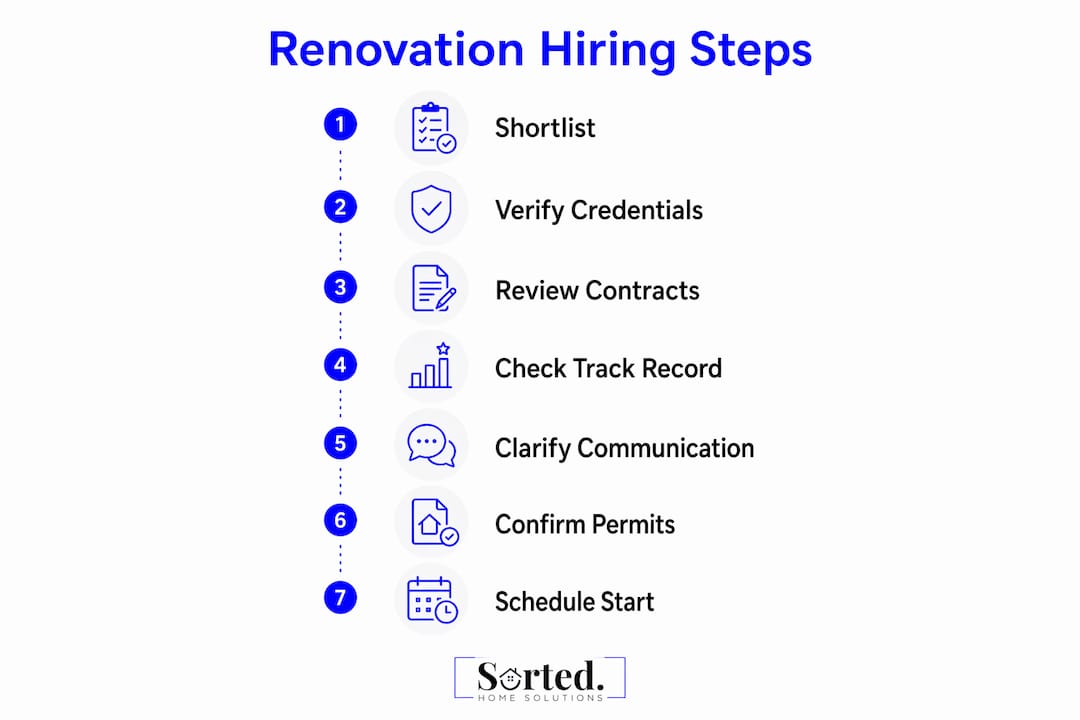
- How to choose a renovation company: your step-by-step hiring checklist
- How do you verify a builder's credentials in New Zealand?
- What contract type should you use for a renovation?
- How do you assess a renovation company's track record?
- Who runs the job and how are trades coordinated?
- What does a renovation cost in Auckland, and how long does it take?
- What are the red flags and the 12 questions to ask at quote stage?
- Why does a full-service, project-managed approach reduce your risk?
- How do you pick one company from your shortlist?
- Key takeaways
- What experienced builders wish homeowners had asked first
- Sortedhomesolutions: full-service renovation management in Auckland
- Useful New Zealand sources and tools
How to choose a renovation company: your step-by-step hiring checklist
A consistent checklist for every company you interview makes comparison straightforward. Use the template below for each phone call, site visit, and quote review.
For each company, record:
- Company name, trading name, and NZBN (New Zealand Business Number).
- Full name and LBP licence ID of every person who will perform RBW on your project.
- LBP licence class confirmed on the public register (yes/no, date checked).
- Insurance type, insurer name, and policy expiry date.
- Contract type offered: fixed-price, estimate with allowances, or time-and-materials.
- Scope inclusions: exactly what is and is not covered in the quoted price.
- Payment schedule: milestones and amounts.
- Defect repair period and how it is documented.
- Referee names and contact numbers (minimum two).
- Who is the single point of contact throughout the project?
During a site visit or face-to-face meeting, also note:
- How clearly the representative explains the scope and likely variations.
- Whether they ask questions about your priorities, timeline, and budget, or only talk about their own process.
- How they respond when you ask about past delays or cost escalations on previous jobs.
- Whether they can show you a completed local project in person.
How many companies should you shortlist? Three is the practical minimum for a meaningful comparison. Beyond five, the process becomes difficult to manage and the marginal information gain drops off. Stop collecting quotes once you have three complete, written quotes covering the same scope. Comparing an itemised fixed-price quote against a vague estimate is not a fair comparison, so push every company to quote on the same scope document before you finalise your shortlist.
How do you verify a builder's credentials in New Zealand?

Credentials verification is not optional for work that affects your home's structure or weathertightness. Under New Zealand law, this work is classified as Restricted Building Work and must be done or directly supervised by a Licensed Building Practitioner holding the correct licence class.
Checking the LBP register
The public LBP register at lbp.ewr.govt.nz lets you search by name or licence number. When you look up a practitioner, check:
- Their licence class matches the work they will perform (e.g., Carpentry, Site, Design, Roofing, External Plastering, Foundations, or Bricklaying and Blocklaying).
- Their licence is current, not expired or suspended.
- Their disciplinary history for the past three years shows no serious findings.
A company cannot hold an LBP licence as an organisation. Each individual performing RBW must be personally licensed and listed on the register. Always ask for individual licence IDs, not just a company-level assurance.
Pro Tip: Confirm the licence class for each LBP on your job, not just whether someone on the team is licensed. A Carpentry LBP cannot supervise Roofing RBW. The class must match the task.
The written-contract rule for residential building work costing a significant amount
Section 362F of the Building Act 2004 requires a written contract for any residential building work costing $30,000 or more (including GST). Before you sign, the contractor must also provide a consumer protection checklist and a disclosure statement. These are legal requirements, not optional extras. If a contractor for a high-value job tells you a written contract is not necessary, that is a clear reason to walk away.
Splitting a project into smaller contracts to stay under the contract value threshold is discouraged by Building Performance guidance and can leave you without the protections the law provides.
Insurance to request
- Public liability insurance: Covers damage to your property or third parties during the build.
- Contract works insurance: Covers the partially completed work against damage or loss during construction.
Ask for the insurer's name and policy number, then call the insurer directly to confirm the policy is current. A certificate of currency is the standard document to request.
What contract type should you use for a renovation?
Pricing models vary, and the right choice depends on how well the scope is defined before work starts.
| Contract type | How it works | Best for | Key risk |
|---|---|---|---|
| Fixed-price | One agreed price for a defined scope | Well-defined projects with detailed plans | Scope creep if variations are not managed |
| Estimate with allowances | Base price plus provisional sums for unknowns | Projects with some undefined elements | Allowances can be set low to win the job |
| Time-and-materials | Hourly/daily rates plus actual material costs | Small or exploratory work | Cost can escalate with no ceiling |
For most Auckland homeowners undertaking a kitchen, bathroom, or whole-house renovation, a fixed-price contract with a clear variation process is the lowest-risk option. Estimates with allowances are reasonable when some elements genuinely cannot be priced until demolition reveals what is behind the walls, but the allowance amounts should be realistic, not artificially low.
Under Building Performance guidance, residential building contracts for $30,000 or more must include minimum content: a description of the required work, payment schedule, dispute resolution process, and acknowledgment of the consumer protection documents. Implied warranties also apply, including a 12-month defect repair period, regardless of whether these are written into the contract.
Contract clause checklist — insist on all of these:
- Full scope description with inclusions and exclusions stated explicitly.
- Allowance schedule with realistic provisional sums for unknown items.
- Variation process: written approval required before any change is made, with cost and time impact stated.
- Payment schedule tied to defined milestones, not calendar dates.
- Dispute resolution process (mediation before escalation).
- Insurance details for both public liability and contract works.
- Workmanship warranty period and what it covers.
- Who is responsible for obtaining building consents and code compliance certificates.
Pro Tip: If a contractor proposes a variation verbally and asks you to approve it on the spot, slow down. Under implied contract terms, your contractor must advise you in writing of the cost and time impact within 10 working days of receiving a variation request. Verbal approvals create disputes. Insist on written variations every time.
How do you assess a renovation company's track record?
A portfolio is only useful if the work shown is comparable to yours. Photos of a high-end kitchen renovation tell you little about how the company handles a weathertightness repair or a structural alteration.
What to look for in a portfolio
- Projects of similar scope and complexity to your own.
- Auckland-specific examples, particularly any work involving weathertightness, which is a known challenge in the local climate.
- Before-and-after photography that shows the condition of the site at handover, not just the finished aesthetic.
- Evidence of building consent and code compliance certificate (CCC) completion on projects that required it.
You can view before-and-after renovation results from local Auckland projects to get a sense of what finished work should look like at handover.
Questions to ask referees
Call at least two referees from comparable projects. Ask:
- Did the project finish on time and within the quoted price?
- How were variations handled — were you informed in writing before costs changed?
- Was there a consistent site supervisor or did the crew change frequently?
- How did the company communicate during the project? Weekly updates, or only when you chased them?
- Were any defects identified after handover, and how quickly were they resolved?
- Would you hire them again for a project of similar size?
An acceptable answer to question two is: "Yes, we always got a written variation notice before anything changed." An evasive answer, or "it was all pretty informal," is a warning sign.
Using online reviews responsibly
Google reviews and similar platforms are useful for spotting patterns, not for judging individual jobs. Look for:
- A consistent pattern of comments about communication, timeliness, and defect resolution.
- How the company responds to negative reviews. A professional response to a complaint is more informative than the complaint itself.
- Review volume. A handful of five-star reviews from the same month can indicate a one-time push rather than sustained performance.
Pro Tip: Ask the company for a referee from a project that had a problem. Every renovation encounters something unexpected. How a company handled a difficult situation tells you far more than a smooth job that went exactly to plan.
Who runs the job and how are trades coordinated?

Project management is where renovations succeed or fall apart. Before you sign, you need clear answers about who is responsible for what.
The roles you should expect to meet
- Project manager: Responsible for the overall programme, budget tracking, trade sequencing, and your primary point of contact. You should meet this person before signing.
- Site supervisor: On-site daily or near-daily, coordinating trades and managing quality. Confirm whether this is the same person as the project manager or a separate role.
- Trade contractors: Plumbers, electricians, plasterers, painters, and other specialists. Ask whether these are employed directly or subcontracted, and whether the company takes responsibility for their work.
A full-service renovation company takes contractual responsibility for all trades under one agreement. That means one point of contact, one contract, and one party accountable if something goes wrong. The alternative, managing multiple separate contractors yourself, significantly increases your coordination burden and your exposure if trades blame each other for a defect.
For a detailed breakdown of how project management responsibilities work in practice, the renovation project management guide covers communication cadence, trade sequencing, and what a single point of contact actually means day-to-day.
Communication agreement: what to confirm before work starts
- Frequency of progress updates (weekly written summary is a reasonable minimum).
- How you will be notified of delays or cost changes (written notice, not a phone call).
- Site access rules: when can you visit, and who do you contact to arrange it?
- Change request process: who approves variations and what is the turnaround time?
- Who liaises with Auckland Council for consents and inspections?
Pro Tip: Ask specifically: "Who will I call if I have a concern on a Tuesday afternoon?" If the answer is vague, or involves reaching a general inbox, the communication structure is not well defined. You want a named person with a direct number.
Permits, inspections, and council liaison
Confirm in writing who is responsible for obtaining building consents, scheduling council inspections, and obtaining the code compliance certificate at the end of the project. Under implied contract terms, if the contract is silent on this, the responsibility falls to your building contractor. However, it is better to have this stated explicitly in the contract so there is no ambiguity.
What does a renovation cost in Auckland, and how long does it take?
Costs and timelines vary considerably depending on scope, site conditions, and materials. The figures below reflect typical ranges for Auckland residential projects and are intended as planning guides, not fixed quotes.
| Project type | Typical cost range (NZD) | Typical duration |
|---|---|---|
| Bathroom renovation | Cost varies widely based on scope; expect 3–6 weeks | |
| Kitchen renovation | Pricing depends on materials and layout; allow 4–8 weeks | |
| Whole-house renovation | Highly variable pricing; 3–12 months | |
| Structural or weathertightness repair | Estimate only after site inspection; allow at least 4 weeks |
For a more detailed breakdown of kitchen and bathroom costs, the Auckland kitchen and bathroom remodel cost guide provides current pricing context.
Major cost drivers
- Scope changes after work starts: The single largest source of budget overruns. Every change to the agreed scope after demolition begins costs more than if it had been planned upfront.
- Structural or weathertightness issues discovered during demolition: Common in Auckland homes built between the 1990s and early 2000s. Budget a contingency of 10–15% for any project involving cladding or structural elements.
- Site access: Difficult access (steep sections, narrow driveways, multi-storey work) adds cost to materials delivery and trade time.
- Specialist trades: Asbestos removal, heritage compliance, or complex electrical upgrades require licensed specialists and add time.
- Materials supply: Lead times on cabinetry, tiles, and fixtures can extend timelines by weeks if not ordered early.
What extends schedules
Council consent processing times, trade availability, and materials delivery are the three most common causes of delays beyond the contractor's control. Within the contractor's control, poor trade sequencing and late variation approvals are the main culprits. Ask your contractor how they manage trade scheduling and what their process is when a subcontractor is unavailable.
What are the red flags and the 12 questions to ask at quote stage?
Deal-breakers: walk away if you see these
- No written contract offered for a job over $30,000.
- Cannot provide individual LBP licence IDs for the people doing RBW.
- No evidence of current public liability or contract works insurance.
- Evasive or vague answers about how variations are handled.
- A quote significantly lower than all others with no clear explanation of what has been excluded.
- Requests for a large upfront deposit (more than 10–15% before any work begins is unusual).
- Pressure to sign quickly or before you have reviewed the full contract.
Common renovation mistakes, including working without permits and inadequate preparation, are well documented and almost always traceable to a contractor who did not communicate clearly upfront. Avoiding interior renovation mistakes often comes down to asking the right questions before work starts, not after.
The 12 questions to ask every company
- Can you provide the LBP licence ID and class for each person doing Restricted Building Work on my project?
- Will you provide a written fixed-price contract, and does it include a variation process?
- What public liability and contract works insurance do you hold, and can I have a certificate of currency?
- Who is my single point of contact, and how often will I receive progress updates?
- Who supervises the site daily, and is that person an LBP?
- Can you show me two completed Auckland projects of similar scope, and provide referee contacts?
- How do you handle variations — what is the process and turnaround time for written approval?
- What is your payment schedule, and are payments tied to milestones?
- Who is responsible for obtaining building consents and the code compliance certificate?
- What workmanship warranty do you provide, and how is it documented?
- Have you had any disputes with clients in the past two years, and how were they resolved?
- What is your process if a subcontractor is unavailable or a material is delayed?
Recording and comparing answers: Use a simple spreadsheet with one row per company and one column per question. Score each answer as satisfactory, unsatisfactory, or unclear. A company with three or more "unclear" answers on the critical questions (LBPs, insurance, variations) should not progress to your shortlist.
Pro Tip: Question 11 is the one most homeowners skip. A contractor who has never had a dispute is either very new or not being candid. What you want to hear is a clear, calm explanation of what happened and how it was resolved, not a denial that problems ever occur.
If you want to check for formal complaints or disputes, the Building Disputes Tribunal handles residential building disputes in New Zealand, and the Commerce Commission handles consumer protection complaints. Auckland Council's building consent records are also publicly accessible if you want to verify that a contractor's past projects received their CCC.
Why does a full-service, project-managed approach reduce your risk?
When you hire a full-service renovation company, you sign one contract and deal with one point of accountability. If the plumber and the tiler have a sequencing dispute, that is the company's problem to resolve, not yours. If a subcontractor's work fails a council inspection, the company wears the cost of rectification under the contract, not you.
The practical benefits are straightforward:
- One contract covers all trades, so there is no gap in liability between separate contractors.
- Trade sequencing is managed internally, reducing delays caused by one trade waiting on another.
- Building consent applications and council liaison are handled by the company, not delegated to you.
- Variations go through one approval process, so cost and time impacts are tracked in one place.
- A single project manager holds the programme and budget, with one person accountable if either slips.
Hiring a full-service renovation company means you are not the project manager by default. One contract, one contact, one party responsible for the outcome from start to finish. That structure is what separates a managed renovation from a series of separate trades you are left to coordinate yourself.
Sortedhomesolutions operates on exactly this model in Auckland, managing all trades under one agreement with a single point of contact throughout. Their specialist vs all-in-one renovation teams guide explains the practical difference between the two approaches for homeowners weighing up their options.
Pro Tip: Before signing with any full-service company, confirm in writing that the company, not individual subcontractors, holds the contract works insurance and is responsible for obtaining the CCC. Some companies use the "full-service" label but still require you to manage consents or deal directly with subcontractors for defects.
How do you pick one company from your shortlist?
Once you have three complete, written quotes on the same scope, the decision process becomes methodical.
Step-by-step decision flow
- Verification pass/fail: Remove any company that failed the LBP check, cannot provide insurance evidence, or declined to provide a written contract for a $30,000+ job. These are non-negotiable.
- Scope clarity comparison: Review each quote for completeness. Which company has the most detailed scope description, the clearest allowance schedule, and the most explicit exclusions list? Vague scopes lead to disputes.
- Final reference check: Call at least one referee for each remaining company. Use the questions from the proof-of-work section above.
- Insurance and LBP confirmation: Re-confirm that insurance certificates are current and that LBP licence classes match the work in the scope.
- Contract review: Read the full contract before signing. Confirm all required clauses are present: scope, payment schedule, variation process, dispute resolution, and warranty.
- Sign and confirm start date.
Pre-sign checklist
Before you sign, confirm:
- All contract clauses from the checklist in the contracts section are present.
- Payment milestones are tied to defined stages of work, not calendar dates.
- The workmanship warranty period is stated in writing.
- A dispute resolution process is included (mediation before escalation).
- You have a named contact person and their direct phone number.
- Building consent responsibility is assigned to the contractor in the contract.
Allow 10–15 working days between selecting your preferred company and the scheduled start of work. This time is needed for building consent applications (where required), finalising materials orders, and confirming trade availability. Rushing this period increases the risk of delays once work begins.
Key takeaways
Choosing a renovation company in Auckland comes down to three verifiable facts: confirmed LBP credentials, a written contract meeting the $30,000 threshold, and documented proof of comparable local work.
| Point | Details |
|---|---|
| LBP verification is mandatory | Check each individual's licence ID and class on the public register before signing anything. |
| Written contract required at $30,000+ | The Building Act requires a written contract, consumer checklist, and disclosure statement for jobs of this value. |
| Proof of local work matters | Ask for two Auckland referee contacts from comparable projects and call them before shortlisting. |
| Walk away from two red flags | No written contract for $30,000+ work, and no individual LBP IDs for Restricted Building Work, are both immediate disqualifiers. |
| Sortedhomesolutions manages it all | Sortedhomesolutions handles all trades, consents, and project management under one Auckland contract with a single point of contact. |
What experienced builders wish homeowners had asked first
The most common homeowner mistake is not asking the hard questions early enough. Most renovation disputes trace back to something that was unclear at quote stage: a scope that did not list exclusions, a variation process that was never agreed, or an LBP check that was never done because the contractor seemed trustworthy.
Verbal promises are the other recurring problem. A builder says the kitchen will be done by Christmas, or that the allowance for tiles will "definitely cover it." Neither of those statements means anything without a written contract that reflects them. The Building Act's implied terms protect you to a degree, but they are a fallback, not a substitute for a clear written agreement upfront.
What experienced project managers consistently wish homeowners had asked: "Can I see the licence ID for every person doing structural or weathertightness work on my home?" Most homeowners never ask it. The ones who do rarely end up in disputes about who was responsible for a defect.
On variations, the single most effective risk-reduction step is agreeing the variation process in writing before work starts, not after the first unexpected issue appears. Insist on a clause that requires written approval, with cost and time impact stated, before any change is made to the scope. That one clause prevents the majority of variation disputes.
Sortedhomesolutions: full-service renovation management in Auckland
Coordinating multiple trades, managing building consents, and keeping a renovation on budget is a significant undertaking. Sortedhomesolutions removes that burden for Auckland homeowners by handling everything under one agreement, from kitchens and bathrooms to full-house renovations, with a single point of contact from first quote to final handover.

All trades are managed internally, building consent processes are handled by the team, and fixed-fee package pricing for kitchens and bathrooms means you know your costs before work starts. There are no separate contracts to manage and no gap in accountability between trades. If you want to see current pricing or request a quote, the Sortedhomesolutions pricing page lists kitchen and bathroom package options with transparent costs. For a full picture of services and to get in touch directly, visit Sortedhomesolutions.
Useful New Zealand sources and tools
- LBP public register: Search by name or licence number to verify an individual's licence class, current status, and disciplinary history.
- When you need an LBP | Building Performance: Explains which work is classified as Restricted Building Work and which LBP classes apply to each type.
- Contracts for your building project | Building Performance: Covers written contract requirements, implied warranties, and the 12-month defect repair period.
- Before building work starts | Building Performance: Covers RBW classification, written contract obligations, and disclosure requirements before any work begins.
- Choosing tradies | Consumer NZ: Independent guidance on selecting contractors, checking references, and understanding quote red flags.
- Master Builders NZ: Industry body advice on selecting builders, verifying experience, and confirming insurance and guarantees.
- Sortedhomesolutions | Auckland renovation and project management: Full-service renovation services in Auckland with fixed-fee kitchen and bathroom packages and a single point of contact.
- Renovation project management guide | Sortedhomesolutions blog: Practical guidance on project management responsibilities, communication cadence, and trade coordination for Auckland homeowners.
This article provides general information about selecting a renovation company in New Zealand. It is not legal or professional advice. Confirm current rules and requirements with Building Performance, Auckland Council, or a qualified building professional for your specific project.