
Renovation project management is the organised process of planning, coordinating, and overseeing your home renovation to deliver on time, within budget, and to the desired quality standard. In New Zealand, this process is also known as residential construction management, and both terms describe the same discipline. For Auckland homeowners, getting this right means understanding building consents, managing tradespeople, and tracking costs before a single wall comes down. This guide gives you a clear, practical framework for managing a home renovation project from first sketch to final inspection, whether you handle it yourself or bring in professional support.
What does renovation project management actually involve?
Renovation project management covers every decision and action between your initial idea and the finished result. It includes defining the project scope, securing building consents, scheduling tradespeople, tracking the budget, and signing off on completed work. The discipline draws on formal project management principles, including scope definition, risk management, and milestone tracking, applied to a residential building context.
The time commitment is significant. Homeowners managing a standard 3–4 month renovation should expect to spend 10–20 hours per week coordinating and managing their project. Larger builds can push that to 15–30 hours per week. That figure surprises most first-time renovators, who underestimate how much coordination sits behind every tradesperson visit.

Compliance adds another layer. Auckland Council enforces the New Zealand Building Code on all consented work, and managing building consents is a non-negotiable part of the process. Skipping or mishandling consents creates legal and financial risk that can outlast the renovation itself.
Essential preparation before you start project managing a renovation
Good preparation separates renovations that run smoothly from those that spiral. Before any work begins, you need three things locked in: a defined scope, a realistic budget, and the right documents.
The scope defines exactly what you are building, changing, or removing. Without a written scope, tradespeople quote on different assumptions, and costs blow out before the first nail goes in. Pair the scope with a budget that includes a contingency of at least 10–15% for unforeseen costs, which are common in Auckland's older housing stock.
Documents you need before construction starts:
- Project scope document: Written description of all work, finishes, and inclusions
- Budget tracker: Spreadsheet tracking quoted, committed, and actual costs by trade
- Project timeline: Week-by-week schedule from consent lodgement to handover
- Building consent application: Required drawings and specifications for council submission
- Written contracts: Mandatory for all residential building work over $30,000 including GST under New Zealand law
| Document | Purpose | When you need it |
|---|---|---|
| Project scope | Defines all work and finishes | Before quoting |
| Budget tracker | Monitors spend vs. plan | Throughout the project |
| Project timeline | Schedules stages and trades | Before consent lodgement |
| Building consent | Legal approval to build | Before construction starts |
| Written contracts | Protects both parties legally | Before any trade starts work |
A renovation project plan template does not need to be complex. A shared spreadsheet covering scope, budget, and timeline covers the fundamentals for most residential projects. Sortedhomesolutions provides end-to-end planning support for Auckland homeowners who want professional structure from the outset.
Pro Tip: Use a building consent agency to check your drawings before lodging with council. Errors in consent applications cause delays of weeks, not days.
How to plan and schedule your renovation stages
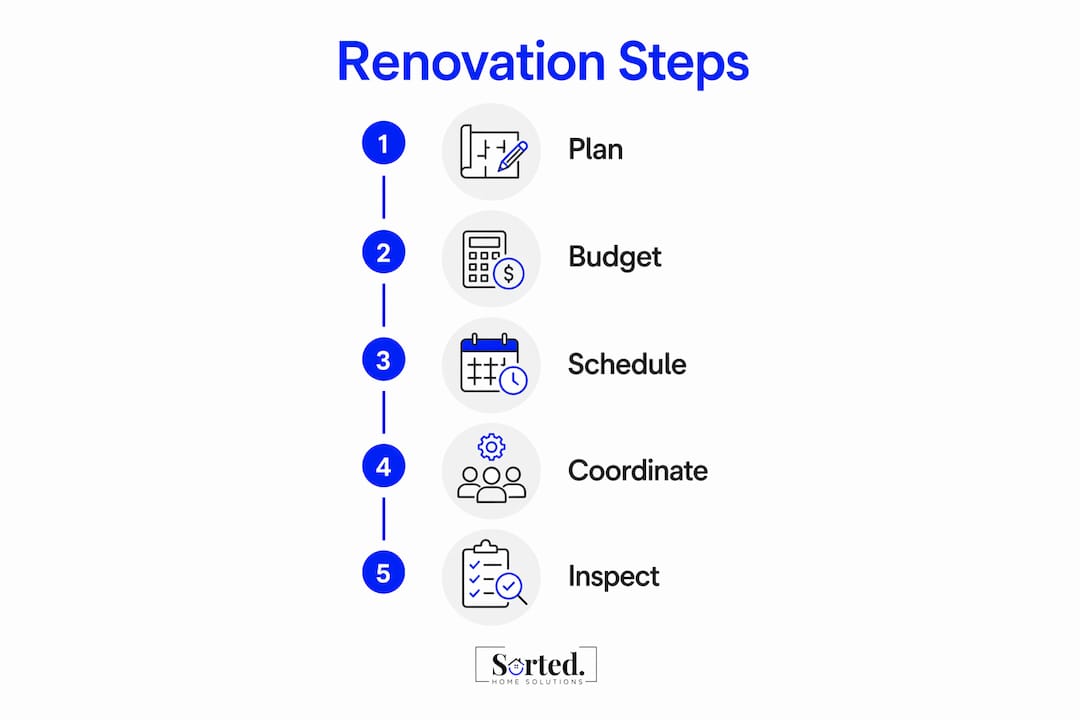
A renovation follows defined stages, and understanding each one lets you build a realistic schedule. The standard sequence is: planning and design, consenting, site preparation, construction, inspections, and handover.
- Planning and design (4–12 weeks): Finalise drawings, select materials, and confirm your budget. This stage sets the ceiling on every decision that follows.
- Consenting (4–8 weeks): Lodge your building consent application with Auckland Council. Planning and consenting can take 4–12 weeks depending on project complexity. Do not schedule tradespeople until consent is granted.
- Site preparation (1–2 weeks): Demolition, protection of existing structure, and delivery of materials. Coordinate skip bin hire and temporary facilities at this point.
- Construction (3–12 months): The longest stage, covering structural, weathertight, plumbing, electrical, and finishing work. Schedule trades in sequence to avoid idle time on site.
- Inspections: Council inspections occur at defined hold points, including foundations, framing, and pre-line. Missing a hold point means stopping work until the inspection is completed.
- Handover: Final inspection, code compliance certificate, and defect remediation. Do not release final payment until the code compliance certificate is issued.
Scheduling tradespeople in Auckland requires lead time. Reliable builders, plumbers, and electricians book weeks or months in advance. Build that lead time into your timeline from day one, not after consent is granted.
Pro Tip: If you work full-time, block two hours every weekday evening and four hours on Saturday for project management tasks. Underestimating this commitment is the single most common reason homeowners lose control of their renovation schedule.
How to manage your renovation budget without overruns
Budget overruns are the most common source of stress in any home renovation project. The causes are predictable: scope changes, unforeseen site conditions, and poor quote comparisons.
Set your budget before you finalise the design, not after. Designs that exceed budget require expensive redesign work. Get a minimum of three written quotes for each trade, and compare them on identical scope. A quote that looks cheaper because it excludes something is not a cheaper quote.
Budgeting best practices for Auckland homeowners:
- Hold a contingency of at least 10–15% of the total build cost for unforeseen items
- Track every expense against the budget weekly, not monthly
- Approve all variations in writing before work proceeds, with a confirmed cost impact
- Pay tradespeople on milestone completion, not on request
- Use a renovation cost calculator to benchmark your estimates before quoting
Professional project managers charge $80–$120 per hour or 8–12% of the total build cost in New Zealand. On a $500,000 build, that is $40,000–$60,000. That figure sounds large, but experienced managers routinely save more than their fee through better procurement, fewer variations, and tighter scheduling.
Pro Tip: Never approve a variation verbally. A written variation order with a confirmed price and timeline impact takes two minutes to produce and prevents disputes that take weeks to resolve.
How to coordinate contractors and maintain quality
Coordinating multiple tradespeople is the most operationally demanding part of managing a house renovation project. Poor coordination creates idle time, rework, and disputes.
Start with thorough vetting. Check that every tradesperson holds a current licence for their trade, carries public liability insurance, and has verifiable references from recent Auckland projects. Communication breakdowns with tradespeople cause the most common renovation delays and quality issues. Clear contracts and regular progress checks are the most effective mitigation.
Key practices for contractor coordination:
- Written contracts for all trades: Include scope, timeline, payment schedule, and dispute resolution process. Contracts are legally required for work over $30,000 including GST.
- Weekly site meetings: Walk the site with your lead tradesperson every week. Document what you see and any issues raised.
- Progress photos: Photograph completed stages before they are covered. This is your evidence if a dispute arises later.
- Defect lists: Maintain a running list of items that need correction. Review it at every site meeting.
- Safety checks: Confirm that all tradespeople comply with WorkSafe New Zealand requirements on site.
Managing quality means checking work against the consented drawings, not just against your own expectations. Any variation from consented plans may require a consent amendment and additional council fees. Catch these early.
Common renovation challenges and how to handle them
Every renovation hits problems. The difference between a project that recovers and one that derails is how quickly you identify the issue and act.
| Challenge | Likely cause | Response |
|---|---|---|
| Timeline slip | Trade unavailability or consent delay | Resequence trades; notify council early |
| Budget overrun | Scope change or unforeseen site condition | Activate contingency; freeze discretionary items |
| Failed inspection | Work not matching consented drawings | Stop work; apply for consent amendment |
| Trade dispute | Unclear contract or verbal variation | Refer to written contract; use mediation if needed |
| Quality defect | Insufficient oversight | Issue written defect notice; withhold final payment |
DIY project management works for smaller projects when homeowners have sufficient time, knowledge of building processes, and commit to regular oversight. Many homeowners find a hybrid approach effective: self-managing administration and communication while engaging a professional for consent management and contractor procurement.
Knowing when to bring in a professional project manager is a practical decision, not an admission of failure. If your project exceeds $300,000, involves structural changes, or you cannot commit 10–20 hours per week, professional management pays for itself. Sortedhomesolutions handles end-to-end project coordination for Auckland homeowners, covering everything from consent lodgement to final handover.
Key takeaways
Effective renovation project management requires defined scope, written contracts, and consistent budget tracking before and throughout construction.
| Point | Details |
|---|---|
| Time commitment is real | Expect 10–20 hours per week for a standard 3–4 month renovation. |
| Consents are non-negotiable | Secure building consent before construction starts to avoid costly delays and failed inspections. |
| Written contracts protect you | New Zealand law requires written contracts for all residential work over $30,000 including GST. |
| Budget with a contingency | Hold 10–15% of the total build cost in reserve for unforeseen items. |
| Hybrid management works | Self-managing some tasks while hiring professionals for others reduces stress and cost. |
What I've learnt from watching homeowners manage their own renovations
The most consistent mistake I see is homeowners treating project management as something they will figure out as they go. They focus on the exciting parts, selecting tiles, choosing kitchen layouts, and leave the coordination work until trades are already on site. By then, the schedule is already under pressure.
The time commitment figure of 10–20 hours per week is not an exaggeration. I have watched capable, organised people hit week three of a renovation and realise they are spending every spare hour on phone calls, quote comparisons, and site visits. That is before anything goes wrong.
The hybrid approach genuinely works. You do not need to hand over full control to get value from professional support. Engaging a professional for consent management and initial contractor procurement, then self-managing the weekly coordination, gives you the best of both. You stay informed and in control, but you are not starting from zero on the parts that require specialist knowledge.
My honest advice: assess your available hours before you commit to self-managing. If you cannot protect 10–15 hours per week for the duration of the build, bring in help for the critical stages. The cost of professional support is almost always less than the cost of a delayed or defective build.
— Rudi
Renovation support from Sortedhomesolutions
Managing a renovation in Auckland is demanding work. Sortedhomesolutions takes on the full coordination load, from initial planning and consent lodgement through to final handover, so you are not carrying it alone.

The team at Sortedhomesolutions covers all trades under one roof, which removes the scheduling complexity that causes most renovation delays. You get a single point of contact, clear timelines, and transparent pricing. Check the renovation pricing page for kitchen and bathroom packages, or reach out directly through the project enquiry form to discuss your specific project. Getting the right support in place early is the most reliable way to protect your budget and your timeline.
FAQ
What is renovation project management?
Renovation project management is the process of planning, scheduling, and overseeing all aspects of a home renovation to deliver the project on time, within budget, and to the required quality standard.
How many hours per week does managing a renovation take?
A standard 3–4 month renovation requires 10–20 hours per week of active management. Larger builds can require 15–30 hours per week.
Do I need a written contract with my builder in New Zealand?
Yes. Written contracts are legally required for all residential building work over $30,000 including GST under New Zealand law, and must include scope, payment schedule, and dispute resolution terms.
When do I need a building consent in Auckland?
Building consent is required before construction starts on most structural, plumbing, and weathertight work. Auckland Council assesses applications against the New Zealand Building Code, and approval typically takes 4–8 weeks.
Should I hire a professional project manager or manage my renovation myself?
A hybrid approach works well for most homeowners: self-manage weekly coordination while engaging a professional for consent management and contractor procurement. Full professional management is worth the cost on projects over $300,000 or where your available time is limited.