
For Auckland homeowners, choosing between specialist and all-in-one renovation teams comes down to one practical question: how much do you want to manage yourself? Specialist trade teams bring deep expertise in a single discipline, such as plumbing, electrical, or tiling, but you coordinate each one yourself. An all-in-one renovation team handles every trade under a single contract, with one point of contact managing the schedule, consents, and quality from start to finish.
Here is a quick comparison to orient your decision:
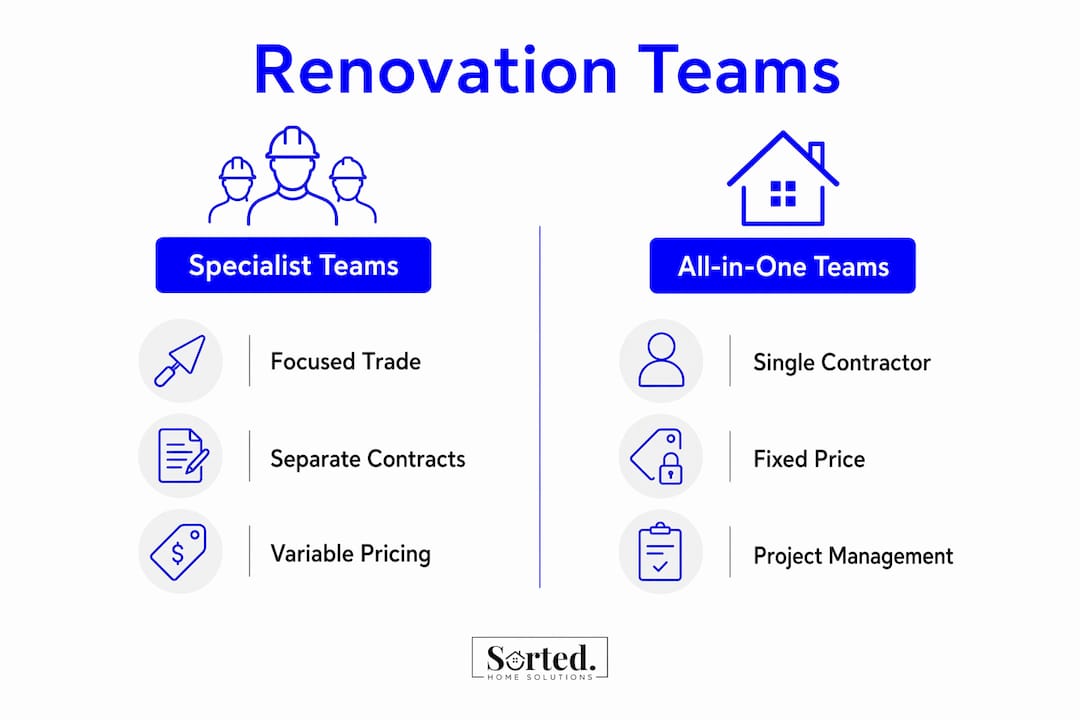
- Specialist teams: deep trade expertise, lower per-trade cost, but you carry the coordination burden
- All-in-one teams: single contract, managed scheduling, fixed pricing, and one person accountable for the outcome
- Project scope matters: small single-trade repairs suit specialists; multi-room or whole-home renovations benefit from integrated management
- Risk tolerance: coordinating multiple trades independently often results in scheduling conflicts and cost blowouts
- Management preference: if you want to hand over responsibility and reduce stress, an all-in-one team is the practical choice
Table of Contents
- How do specialist and all-in-one renovation teams actually differ?
- What criteria should you use to choose the right renovation team?
- Trusted Auckland providers offering all-in-one renovation services
- How to manage your renovation project effectively
- What questions should you ask before hiring a renovation team?
- How do you evaluate references and past work?
- What legal and contract protections should you have in place?
- How does post-renovation support differ between team types?
- Sortedhomesolutions: one team, every trade, fixed price
- Key takeaways
How do specialist and all-in-one renovation teams actually differ?
The structural difference is straightforward. Specialist contractors focus on one trade. You hire a builder, then separately engage a plumber, electrician, plasterer, and painter. Each has their own schedule, invoice, and communication channel. You become the de facto project manager.
All-in-one teams operate differently. One company takes responsibility for the full scope, coordinating all trades internally. Providers like The Renovation Team Ltd manage everything from architect coordination to building consent documentation under a fixed price. Group Complete Renovation offers a fixed-price range guarantee and handles council resource consents as part of their standard service.
Key distinctions worth understanding:
- Pricing model: all-in-one teams typically offer fixed-price contracts; specialist teams bill per trade, making total cost harder to predict
- Communication: a single point of contact versus multiple separate conversations with each contractor
- Scheduling: integrated teams manage trade sequencing internally; self-managed projects depend on your ability to coordinate trades for repairs in the right order
- Accountability: with an all-in-one team, one entity is responsible if something goes wrong; with specialists, disputes between trades can leave you in the middle
- Consents and compliance: all-in-one providers typically manage building consent and Code Compliance Certificate processes; with specialists, that responsibility falls to you
Licensed Renovations Ltd highlights radical transparency and detailed scoping as core to their approach, which reflects a broader pattern among reputable all-in-one providers: clear documentation reduces disputes and keeps budgets on track.
What criteria should you use to choose the right renovation team?
Start with your project's complexity. A single bathroom refresh is manageable with a specialist tiler and plumber. A kitchen and bathroom renovation running simultaneously, with structural changes and new electrical circuits, needs coordinated management.
Questions to guide your evaluation:
- Does the provider hold a Licensed Building Practitioner (LBP) certification? In New Zealand, restricted building work legally requires an LBP.
- Is pricing fixed, or is it an estimate subject to variations?
- Who manages the building consent process, and what happens if consent is delayed?
- How does the team handle unexpected issues mid-project?
- What does their communication process look like day to day?
Red flags to watch for: vague scope documents, verbal-only pricing, no written contract, and contractors who cannot name their subcontractors. Total Home Renovations promotes upfront discussion and transparent pricing as standard practice, which is the baseline you should expect from any provider.
When reviewing customer feedback, look beyond star ratings. Read for specifics: did the team communicate proactively? Were timelines met? How were problems resolved? A provider with consistent positive detail across multiple reviews is more reliable than one with a handful of five-star ratings and no commentary.

Trusted Auckland providers offering all-in-one renovation services
The table below covers leading Auckland providers offering integrated renovation solutions. All information reflects publicly available details.
| Provider | Service scope | Project management | Pricing model | Certifications and recognition | Geographic focus |
|---|---|---|---|---|---|
| The Renovation Team Ltd | Full renovation, architect coordination, consents | End-to-end including Code Compliance Certificate | Fixed price | Licensed practitioners | Auckland-wide |
| Refresh Renovations Auckland Central (John and Maree de Latour) | Kitchens, full home renovations, bespoke design | Consultative, tailored to client lifestyle | Not publicly listed | Refresh Renovations network | Auckland Central |
| Refresh Renovations Auckland Central (Saleem Bhikoo) | Extensions, full-house transformations, kitchens, bathrooms | Hands-on with heritage and council restrictions | Not publicly listed | Home Renovation of the Year Gold; Bathroom of the Year Bronze | Auckland Central |
| Group Complete Renovation | Full build delivery, council consents, design | Fixed-price range with free assessment | Fixed-price range guarantee | Not publicly listed | Auckland |
| Licensed Renovations Ltd | Residential renovations, character home restorations | Detailed scoping, radical transparency | Not publicly listed | Licensed building company | Auckland |
| Refresh Renovations West Auckland (Dominic Hollands) | Full renovations, engineering project management | Deep process knowledge, award-winning service | Not publicly listed | Service and renovation awards | West Auckland |
| Total Home Renovations | Full home renovations | Upfront discussion, no surprise costs | Transparent, fair pricing | Not publicly listed | Auckland |
| Renovation Builders | Design, build, recladding, sustainable renovations, character homes | Professional team with project management | Not publicly listed | Not publicly listed | Auckland |
| Sortedhomesolutions | Kitchens, bathrooms, building, plumbing, electrical, plastering, painting, flooring, small jobs | Single point of contact, all trades managed | Fixed-fee with tiered packages | Licensed practitioners | Auckland |
How to manage your renovation project effectively
Once you have chosen your team, your role shifts from decision-maker to informed client. Clear communication from day one prevents most problems.
Practical steps:
- Agree on a written scope of works before any work begins, including materials, finishes, and allowances
- Set a communication schedule: weekly updates at minimum, with a named contact for urgent issues
- Review milestones against the agreed timeline; ask for a revised programme if delays occur
- Keep a written record of any changes to scope, cost, or timeline
- Do not approve variations verbally; request written confirmation before work proceeds
Monitoring trade sequencing is worth your attention even when a team manages it internally. Understanding that plastering follows framing, and painting follows plastering, helps you ask the right questions if progress stalls.
Pro Tip: Ask your renovation team for a one-page project schedule at the outset. A provider who cannot produce a basic timeline before work starts is unlikely to manage a complex sequence of trades well.
Post-renovation, confirm that all Code Compliance Certificate documentation has been lodged and received. For guidance on renovation project management, including how to handle disputes and variations, a structured homeowner's guide covers the key steps in detail.
What questions should you ask before hiring a renovation team?
The questions differ depending on which model you are considering.
For an all-in-one team:
- Who is my single point of contact, and how available are they during the project?
- Which trades do you employ directly, and which do you subcontract?
- How do you handle building consent applications and Code Compliance Certificates?
- What does your fixed-price contract cover, and what triggers a variation?
For a specialist trade team:
- Are you licensed for the specific restricted building work this project involves?
- How do you coordinate with other trades on site?
- What happens if your schedule conflicts with another trade I have booked?
- Who is responsible if your work needs to be redone due to another trade's error?
The last question is particularly important. When you hire contractors independently, disputes between trades can leave you bearing costs that no single contractor accepts responsibility for.
How do you evaluate references and past work?
Ask every provider for at least three references from projects similar in scope and budget to yours. When you contact those references, ask specific questions: Was the final cost within the original quote? Were there delays, and how were they communicated? Would you use this team again?
Viewing completed work in person is more useful than photos. Photos can be staged; a finished bathroom or kitchen tells you about material quality, junction details, and finish consistency. Ask to visit a recently completed project if the provider can arrange it.
Online reviews on Google are a useful signal, but read for patterns rather than individual ratings. A provider with consistent comments about communication, timeline adherence, and problem resolution is demonstrating repeatable performance.
What legal and contract protections should you have in place?
In New Zealand, any restricted building work must be carried out or supervised by a Licensed Building Practitioner. This covers structural work, weathertightness, and certain plumbing and electrical tasks. Confirm LBP status before signing any contract.
Your written contract should include: a detailed scope of works, a fixed or capped price with clear variation procedures, a payment schedule tied to milestones, a dispute resolution process, and a defects liability period. Avoid contracts that require large upfront deposits before work begins; a reasonable deposit is typically no more than 10–20% of the total project value.
For building consent, confirm in writing who is responsible for lodging the application and who holds the consent documentation at completion. Gaps in this process can affect your ability to sell the property later.
How does post-renovation support differ between team types?
All-in-one providers typically offer a defined defects liability period, during which they return to fix any issues that arise from their work. Because one entity is responsible for all trades, there is no ambiguity about who addresses a problem. A leak at the junction of new plumbing and new tiling, for example, is clearly within their scope.
With specialist teams, post-renovation accountability is more complicated. Each trade is responsible only for their own work. If a problem sits at the boundary between two trades, resolving it may require you to manage the dispute yourself.
Warranties on materials and workmanship also differ. All-in-one providers often pass through manufacturer warranties on products and offer their own workmanship guarantee. With specialists, you hold separate warranties from each contractor, and coordinating a claim across multiple parties takes time.
Sortedhomesolutions: one team, every trade, fixed price
If this article has confirmed that you want a single point of contact managing every aspect of your renovation, Sortedhomesolutions is built precisely for that. Every trade, including building, plumbing, electrical, plastering, painting, cabinetry, and flooring, is managed under one team. You deal with one contact, receive one fixed price, and hand over the coordination entirely.

For Auckland homeowners who want their renovation handled from consent to completion without managing trades themselves, Sortedhomesolutions offers tiered fixed-fee packages for kitchens and bathrooms, as well as full-service project management for larger renovations. You can review transparent pricing for kitchen and bathroom packages online, or visit Sortedhomesolutions to start a conversation about your project.
Key takeaways
All-in-one renovation teams reduce coordination risk, provide fixed pricing, and give Auckland homeowners a single accountable contact for the full project scope.
| Point | Details |
|---|---|
| Project complexity drives the choice | Multi-trade or whole-home renovations benefit from integrated management; single-trade jobs suit specialists. |
| Fixed pricing reduces budget risk | All-in-one providers typically offer fixed-price contracts or fixed-fee tiered packages, making total costs predictable from the outset. |
| LBP certification is non-negotiable | Restricted building work in New Zealand must be carried out by a Licensed Building Practitioner. |
| Post-renovation accountability differs | All-in-one teams carry responsibility across all trades; specialist teams each cover only their own scope. |
| Sortedhomesolutions covers every trade | Fixed-fee packages, single point of contact, and full trade management from consent to completion in Auckland. |