
Choosing between DIY vs professional renovation is the decision to either complete home improvements yourself or hire licensed tradespeople with the skills, tools, and legal accountability to do the work correctly. For Auckland homeowners, this choice carries real financial and legal weight. New Zealand's Building Act 2004 sets strict rules about what work requires consent, who is liable when things go wrong, and what penalties apply to unauthorised work. Getting this decision right protects your home, your budget, and your property's resale value.
What are the cost differences between DIY and hiring professionals?
Professional renovation costs more upfront. That is the simple truth. But the full picture is more complicated, because DIY mistakes carry their own price tag.
Architectural fees for residential renovations in New Zealand typically run between 8% and 15% of the total project cost. On a $50,000 kitchen renovation, that is $4,000 to $7,500 in design fees alone. That figure sounds steep until you factor in what you get: accurate plans, faster consent approvals, and a design that actually works spatially.
DIY home improvements appear cheaper at the start. You skip labour costs and control your own schedule. The risk is that errors compound quickly. A tiling job done incorrectly means ripping out and redoing the work. A structural mistake can require expensive retrofitting or trigger a Notice to Fix from the council.
- Labour savings are real but require genuine skill to capture
- Material waste from DIY errors often offsets initial savings
- Consent delays caused by incomplete or incorrect documentation add time and cost
- Resale value drops when buyers discover unconsented or substandard work
Pro Tip: Use the renovation cost calculator from Sortedhomesolutions to build a realistic budget before committing to either path. Knowing your numbers upfront prevents the most common cost blowouts.
Professional design input also improves the long-term usability of your home. Professional designers enhance spatial quality in kitchens and bathrooms in ways that directly affect resale value. That return on investment is difficult to replicate with a DIY approach unless you have formal design training.
How do NZ building regulations affect your renovation choices?
New Zealand's regulatory framework is the single biggest factor most homeowners underestimate when weighing up contractor vs DIY work. Getting it wrong is expensive.
Under the Building Act 2004, most structural or plumbing work requires a building consent before work begins. Exemptions exist but they are narrow. Sheds under 10m² and decks under 1.5m in height avoid the consent process. Almost everything else, including kitchen and bathroom renovations involving plumbing changes, requires consent.
The rules changed again in january 2026. Standalone dwellings up to 70m² can now be built without building consent, provided strict technical and record-keeping conditions are met. This sounds like a win for DIY builders. In practice, it shifts the compliance burden directly onto the homeowner, with no council oversight to catch errors before they become expensive problems.
Homeowners acting as their own project managers and compliance officers face complex rules that may cause expensive retrofitting if misunderstood. Recent regulatory shifts increase the homeowner's compliance burden and risk significantly.
The legal responsibility question is equally clear. Under Section 14B of the Building Act 2004, the property owner retains legal responsibility for building consent and final code compliance, regardless of who does the work. You can delegate the application to a builder or architect, but you cannot delegate the liability.
The consequences of getting this wrong are severe:
- Notice to Fix issued by the council, requiring remediation at your cost
- Court fines for unauthorised work. An Auckland District Court case resulted in a $52,500 fine for building a retaining wall without consent
- Insurance voidance if a claim relates to unconsented work
- Sale complications when a LIM report reveals unconsented structures
Pro Tip: Check the building consent agencies approved in your area before starting any project. Knowing which agency handles your consent saves time and avoids submitting to the wrong body.
What skill and time gaps exist between DIY and professional work?
The quality gap between DIY and professional renovation is real, and it widens as project complexity increases. Painting a bedroom is a reasonable DIY task. Relocating a load-bearing wall is not.

Most renovation tasks require a combination of practical skill, tool knowledge, and an understanding of how building systems interact. A DIY kitchen renovation in NZ, for example, involves cabinetry installation, benchtop fitting, plumbing connections, electrical work, and tiling. Each trade has its own standards. Electrical and plumbing work must be completed by licensed tradespeople regardless of your personal skill level.
Time is the other hidden cost. Homeowners consistently underestimate how long DIY projects take. A professional team completes work in a compressed timeframe because they work full days, carry the right tools, and do not need to learn on the job. A DIY project stretched across weekends can take three to four times longer, disrupting your household and extending the period your home is partially functional.
- Inspections are harder to pass when work is done in stages over a long period
- Subcontractor coordination is a skill in itself, and DIY project managers often struggle with sequencing trades correctly
- Design errors discovered mid-build are far more expensive to fix than errors caught at the planning stage
Pro Tip: Read the homeowner's guide to renovation project management before you start. Understanding sequencing and trade coordination prevents the most common and costly DIY delays.
Professional project management also protects quality at every stage. A licensed builder knows which inspections are required, when to call them, and how to document the work for the Code Compliance Certificate. That documentation protects you at resale.
How do you decide when to DIY and when to hire a professional?
The right home renovation choice depends on four factors: project complexity, regulatory requirements, your actual skill level, and your available time. Honest answers to these questions produce a clear decision.
Use this framework to assess your project:
| Factor | DIY is reasonable | Hire a professional |
|---|---|---|
| Structural work involved | No structural changes | Load-bearing walls, foundations |
| Plumbing or electrical | Surface cosmetic only | Any pipe or wiring relocation |
| Building consent required | Exempt minor work only | Any consented work |
| Your skill level | Relevant trade experience | No formal training |
| Project timeline | Flexible, no urgency | Fixed deadline or rental property |
| Budget for errors | Can absorb cost of mistakes | Cannot afford rework costs |
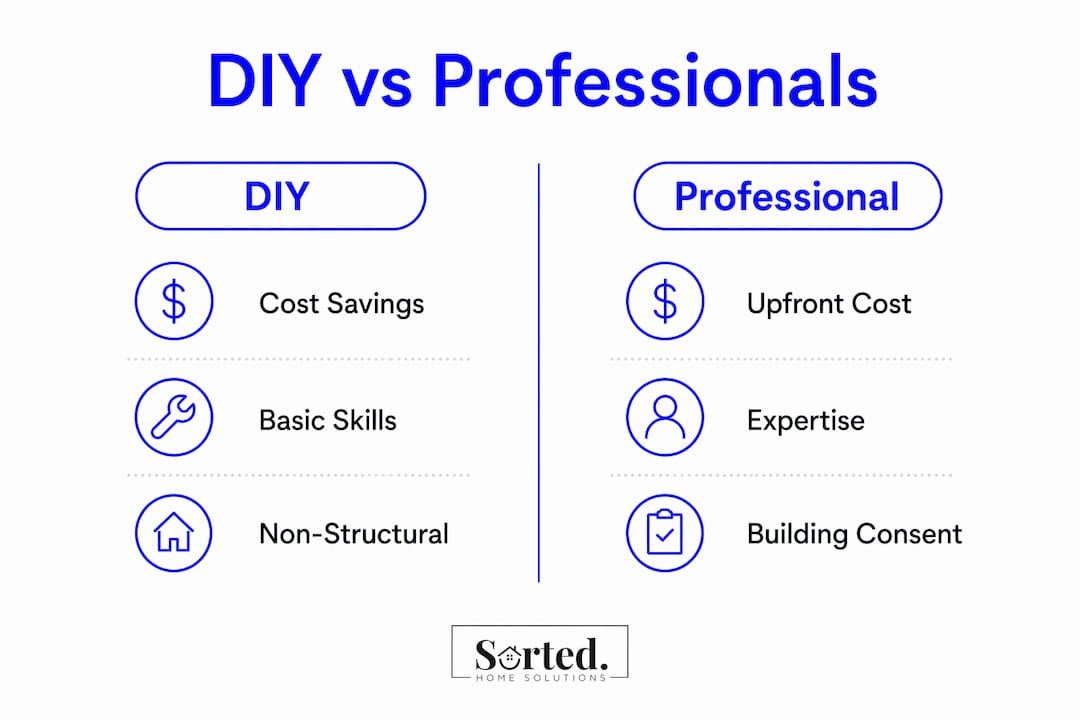
A hybrid approach works well for many Auckland homeowners. You handle the painting, landscaping, and demolition. Licensed tradespeople handle the electrical, plumbing, and structural elements. This combination captures real savings without creating compliance risk.
Pro Tip: Always verify a tradesperson's licence before engaging them. Licensed Building Practitioners (LBPs) are registered with the Ministry of Business, Innovation and Employment (MBIE) and their status is publicly searchable. This takes two minutes and protects you from liability.
The decision also shifts depending on your property type. Older Auckland homes, particularly those built before 1980, often contain asbestos or other hazardous materials that require licensed removal. Assuming otherwise creates health and legal risk that no DIY saving justifies.
Key takeaways
The safest and most cost-effective renovation approach combines DIY tasks where you have genuine skill with professional tradespeople for any work that requires consent, involves structural changes, or touches plumbing and electrical systems.
| Point | Details |
|---|---|
| Regulatory liability stays with you | Under the Building Act 2004, the property owner is legally responsible for consent and code compliance regardless of who does the work. |
| Professional fees deliver measurable return | Architectural fees of 8%–15% of project cost improve design quality, speed up consents, and protect resale value. |
| Unconsented work carries serious penalties | Auckland courts have issued fines of $52,500 for work completed without consent. Insurance cover can also be voided. |
| A hybrid approach captures the best of both | Handle painting, landscaping, and demolition yourself. Use licensed tradespeople for electrical, plumbing, and structural work. |
| Time cost is real and often underestimated | DIY projects routinely take three to four times longer than professional equivalents, disrupting your household and extending compliance risk. |
What I've learnt from watching homeowners get this wrong
I've seen the same pattern repeat itself. A homeowner starts a renovation with good intentions and a tight budget. They decide to manage the whole project themselves to save money. Six months later, they are dealing with a Notice to Fix, a failed inspection, and a builder quoting twice the original estimate to fix the errors.
The mistake is not attempting DIY work. The mistake is misjudging which tasks are genuinely within reach. Painting, tiling a splashback, fitting flat-pack cabinetry, and basic landscaping are all reasonable for a capable homeowner. Anything involving the building's structure, its plumbing, or its electrical systems is not. That line is not about confidence. It is about legal accountability and the technical knowledge required to meet New Zealand's building code.
The regulatory changes around granny flats and consent-exempt dwellings have made this more complicated, not less. The absence of a consent process does not mean the absence of standards. It means you are now the person responsible for meeting those standards without a council inspector checking your work.
My honest advice: spend money on professional design input early. A good designer catches problems before they become expensive. They also produce documentation that makes the consent process faster and your resale process cleaner. That investment pays for itself. The homeowners who struggle most are those who treat professional advice as optional rather than as the foundation of a well-run project.
— Rudi
Renovation support from Sortedhomesolutions in Auckland
Deciding between DIY and professional renovation is easier when you have clear pricing and a team that handles every trade under one roof.

Sortedhomesolutions works with Auckland homeowners from the first conversation through to the final inspection. The team covers all trades, which means no coordinating between separate contractors and no gaps in accountability. You can review kitchen and bathroom renovation pricing upfront so your budget is grounded in real figures before any work begins. For homeowners who want professional support without the stress of managing multiple trades, Sortedhomesolutions is the straightforward option. Get in touch to talk through your project and find out what the professional path looks like for your home.
FAQ
What work requires building consent in New Zealand?
Most structural and plumbing renovations require building consent under the Building Act 2004. Only minor cosmetic work and specific exempt items, such as sheds under 10m², avoid the consent process.
Can I legally do my own renovation work in NZ?
You can complete certain tasks yourself, including painting, tiling, and fitting cabinetry. Electrical and plumbing work must be completed by licensed tradespeople, and any consented work requires documentation and inspection.
What happens if I build without consent in Auckland?
Unauthorised building work can result in a Notice to Fix, court fines, and insurance complications. An Auckland District Court case resulted in a fine of $52,500 for a retaining wall built without consent.
Who is responsible for building consent if I hire a builder?
The property owner remains legally responsible for building consent and code compliance under Section 14B of the Building Act 2004, even when a builder or architect manages the application.
Is a hybrid DIY and professional approach worth it?
Yes. Handling painting, demolition, and landscaping yourself while using licensed tradespeople for electrical, plumbing, and structural work captures real savings without creating compliance risk or legal exposure.