
A typical bathroom renovation in New Zealand takes several weeks on-site, but the total project time from the first design meeting to final sign-off commonly runs significantly longer once you include planning, material ordering, and building consents. That gap surprises most homeowners. The sledgehammer-to-shower window is short; everything around it is not.
Your scope determines which end of that range applies to you:
- Minor refresh (new tapware, vanity, paint, no plumbing moves): 1–2 weeks on-site, 4–6 weeks total including selections and ordering.
- Standard renovation (new layout, tiling, full fixture replacement): 3–4 weeks on-site, with total time commonly 8–16 weeks including planning and consents.
- Full gut or custom build (structural changes, relocated plumbing, custom cabinetry, consent required): multiple weeks on-site, with total time considerably longer due to planning and consents.
Auckland Council's statutory consent processing window starts upon acceptance of a complete application, with official timelines applying from that point. If your project triggers consent, that window alone adds roughly four calendar weeks to your schedule before a single trade sets foot on site.
Sortedhomesolutions manages the full process for Auckland homeowners, from design and procurement through to final sign-off, so you are not left tracking each stage yourself.

Table of Contents
- How long does a bathroom renovation take by project scope?
- What happens in each phase of the bathroom remodel process?
- What should you do before work starts?
- What causes delays, and how do you plan for them?
- How do you keep the project on schedule with your builder?
- What NZ rules affect your schedule? Consents, PS3s, and inspections
- Key takeaways
- Why a single project manager changes the schedule equation
- Sortedhomesolutions: fixed-fee bathroom renovations in Auckland
- What the editorial evidence actually says about bathroom timelines
- The part of the timeline nobody talks about honestly
- Useful sources and further reading
How long does a bathroom renovation take by project scope?
The three scope tiers below cover the vast majority of residential bathroom projects in New Zealand. The table separates on-site build time from total project time, because conflating the two is the most common reason homeowners are caught off guard.
| Project scope | On-site build time | Total project time | Typical phase lengths | Material lead times |
|---|---|---|---|---|
| Minor refresh (cosmetic only, no plumbing moves) | 1–2 weeks | 4–6 weeks | Demo/prep: 1 day; painting/fit-off: 3–5 days | Standard tapware/vanity: 1–3 weeks |
| Standard renovation (new layout, full tiling, fixture replacement) | 3–4 weeks | 8–16 weeks | Demo: 2–3 days; rough-in: 3–5 days; waterproofing + cure: 5–7 days; tiling: 4–6 days; fit-off: 2–3 days | Tiles: 2–4 weeks; tapware: 2–3 weeks; shower screen: 3–5 weeks |
| Full gut / custom build (structural, relocated plumbing, consent required) | 4–8 weeks | 16–20 weeks | All standard phases plus framing, inspections, consent processing | Custom vanity: 6–10 weeks; custom cabinetry: 8–10 weeks |
A few notes on exceptions. Custom cabinetry and bespoke shower screens are the two items most likely to push a standard renovation into the full-gut timeline, not because the build is complex, but because fabrication takes time. Structural changes that require new framing or relocated load-bearing elements add inspection hold points that cannot be compressed. If your project sits on the boundary between standard and full gut, treat the longer range as your working assumption.
What happens in each phase of the bathroom remodel process?
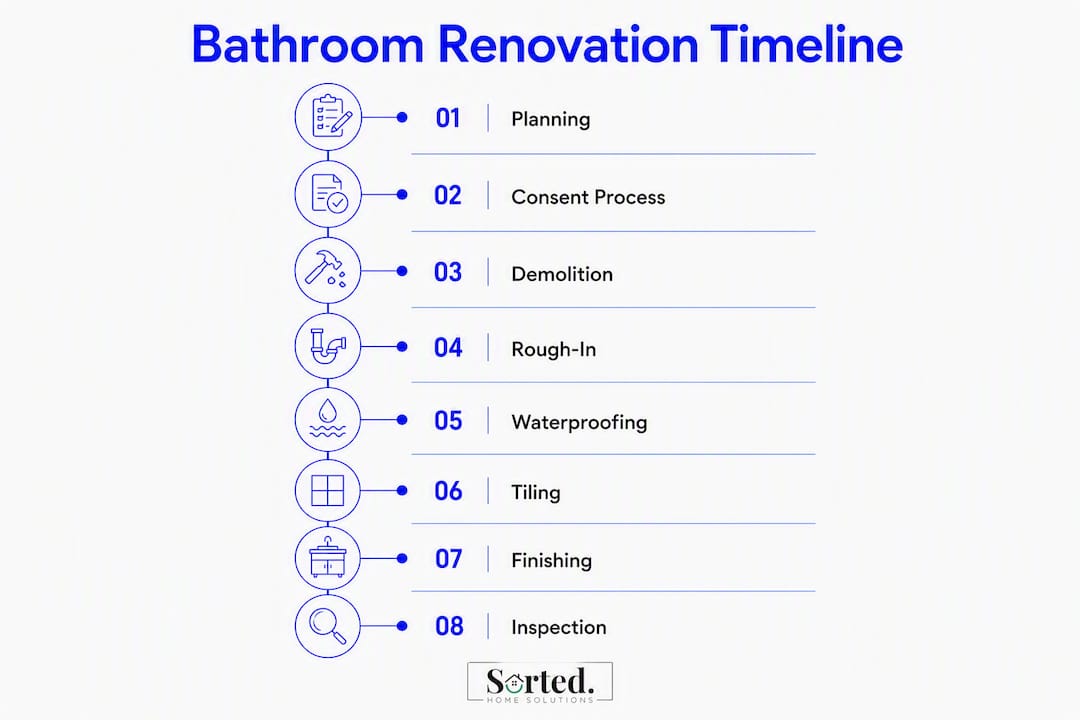
A standard 3–4 week on-site schedule follows a clear sequence. Each phase has a defined owner, a handover point, and at least one hold point you should confirm before the next trade arrives.
Week-by-week breakdown for a standard renovation
Pre-start (weeks 1–8 before on-site start): Design finalised, selections made, materials ordered, consent lodged if required. This is the phase most homeowners underestimate.
Week 1 on-site:
- Days 1–2: Demolition and disconnect. Builder strips fixtures, tiles, and linings. Plumber and electrician disconnect services. This is when hidden issues surface.
- Days 3–5: Rough-in plumbing and electrical. Plumber relocates or extends waste and supply lines. Electrician runs new circuits for heated towel rails, exhaust fans, and lighting. Both trades must complete rough-in before linings go on.
Week 2 on-site:
- Days 6–8: Lining and substrate. Builder installs waterproof substrate (Hardiebacker or equivalent) and prepares surfaces. Waterproofer applies membrane to floor and wet-wall junctions.
- Days 9–10: Waterproofing hold point. Membrane must cure fully before tiling begins. The waterproofer provides a PS3 (Producer Statement Construction) confirming compliant installation. Do not allow tiling to start before the PS3 is in hand and the cure window has passed.
Week 3 on-site:
- Days 11–15: Tiling. Tiler lays floor and wall tiles. Waterproofing and tile cure time are the most schedule-sensitive stages on any bathroom build. Grout requires its own drying window before wet use.
Week 4 on-site:
- Days 16–18: Fit-off and fixtures. Plumber connects vanity, toilet, shower, and tapware. Electrician fits switches, exhaust fan, and lighting. Glazier installs shower screen.
- Days 19–20: Commissioning and snagging. Builder checks all junctions, silicone seals, and finishes. Final inspection if consent was required. Code Compliance Certificate issued once council is satisfied.
Who attends each phase
| Phase | Trades on-site |
|---|---|
| Demolition | Builder |
| Rough-in | Plumber, electrician |
| Lining and waterproofing | Builder, waterproofer |
| Tiling | Tiler |
| Fit-off | Plumber, electrician, glazier |
| Commissioning | Builder, plumber |
Pro Tip: Book your tiler immediately after waterproofing is confirmed, not before. A tiler who arrives before the PS3 is issued and the membrane has cured will either stand down (costing you a scheduling gap) or start too early (risking a failed waterproofing inspection). Sequencing that one handover correctly keeps the whole back half of the schedule intact.
What should you do before work starts?
Pre-construction planning is where most bathroom remodel schedules either hold together or fall apart. Decisions left unmade at the start become delays mid-build.
Pre-start checklist
Complete these before your builder's start date:
- Final floor plan and fixture positions confirmed in writing
- All tiles selected, ordered, and delivery confirmed (allow 2–4 weeks)
- Tapware and shower fittings ordered (allow 2–3 weeks for standard; longer for imported brands)
- Shower screen or frameless glass ordered (allow 3–5 weeks)
- Vanity confirmed on-site or delivery date locked in
- Consent application lodged if required (allow 20 working days minimum)
- Electrician and plumber booked for rough-in dates
- Waterproofer booked and PS3 process confirmed
Booking trades and ordering materials at least 6–8 weeks ahead is the recommended lead time for Auckland projects. Rural locations often need longer windows for specialist trades. Starting procurement after your builder's start date is confirmed is too late for most long-lead items.
Late tile deliveries are the single most common cause of tiler stand-downs. A tiler who arrives on Day 11 to find tiles still in transit will reschedule to their next available slot, which may be two weeks away. That one gap can push your total project time out by three weeks.
Contractor-managed procurement reduces this risk because the contractor sequences deliveries to match each trade's window, rather than leaving the homeowner to coordinate multiple suppliers independently.
What causes delays, and how do you plan for them?
Hidden repairs are the most frequently reported cause of unexpected schedule extensions once demolition exposes the structure. You cannot see rotting framing, non-compliant plumbing, or outdated wiring until the tiles come off. Planning for that possibility is not pessimism; it is accurate scheduling.
Common delay causes
- Hidden water damage or rotting timber: Wet areas in older homes frequently conceal framing damage behind tiles. Remediation adds 2–5 days depending on extent.
- Non-compliant legacy plumbing or wiring: Pre-1990s homes often have copper or galvanised pipes and wiring that does not meet current standards. Bringing these up to code adds trade time and may require additional consent documentation.
- Late material deliveries: Tiles, custom vanities, and imported tapware are the most common offenders. Allow buffer stock for breakages on tile orders (order 10–15% extra).
- Council RFIs (Requests for Information): An incomplete consent application triggers an RFI, which pauses the statutory 20-working-day clock entirely. A single RFI round can add 2–4 weeks to consent processing.
- Tradie scheduling gaps: If one trade finishes early or late, the next trade's availability may not align. This is particularly common when homeowners self-manage procurement and bookings.
Contingency guidance
Build a 10–15% time buffer into your total project schedule. On a 10-week project, that means holding two weeks in reserve before you commit to a hard move-back date or a fixed event tied to completion. For budget, a similar contingency percentage applied to your total contract value covers most hidden-repair scenarios without requiring a full project restart.
Pro Tip: Before demolition begins, ask your builder to do a pre-demo inspection: probe wet-area walls for soft spots, check under the vanity for signs of past leaks, and review the age of visible plumbing fittings. Thirty minutes of checking before the first tile comes off can surface issues that would otherwise cost you a week mid-build.
How do you keep the project on schedule with your builder?
Clear milestones and a simple communication routine are the two most practical tools for keeping a bathroom remodel on track. You do not need a formal project management system; you need agreed checkpoints and a single point of contact.
Sample milestone schedule
Use these checkpoints to confirm progress at each stage:
- Pre-start confirmed: All materials on-site or delivery dates locked; consent lodged or confirmed not required; all trades booked.
- Demolition complete: Structure inspected; hidden issues documented and scoped; any variation to contract agreed in writing.
- Rough-in signed off: Plumber and electrician have completed rough-in; photos taken before linings go on; any inspection by council completed.
- Waterproofing PS3 provided: PS3 document in hand; membrane cure window confirmed; tiler booked for confirmed start date.
- Tiles laid and grouted: Grout cure window confirmed; fit-off trades booked.
- Fit-off complete: All fixtures connected and tested; snagging list completed and signed off.
- Final inspection and CCC: Code Compliance Certificate received (if consent was required); all documentation filed.
At each milestone, request a short written update (even a text message with a photo) confirming what was completed, what is next, and whether the schedule has changed. A weekly five-minute check-in is enough for most projects. The goal is to catch a one-day slip before it becomes a one-week slip.
Contractual levers worth knowing
Two contract provisions protect your schedule and quality. Provisional sums cover work that cannot be fully scoped until demolition (hidden repairs are the classic case); they give your builder authority to proceed with remediation without stopping for a new quote. Retention clauses hold back a percentage of payment until final sign-off, which gives both parties a clear incentive to close out the snagging list promptly. Ask your builder whether these are included in your contract before work starts.
Renovation project management handled by a single lead contractor removes most of the coordination burden from you, because the contractor owns the milestone schedule and manages trade sequencing directly.
What NZ rules affect your schedule? Consents, PS3s, and inspections
Building consent requirements and waterproofing compliance are the two regulatory areas most likely to affect your bathroom renovation schedule in New Zealand. Both are governed by the Building Act 2004 and administered locally by Auckland Council.
When does a bathroom renovation require building consent?
| Work type | Consent required? |
|---|---|
| Like-for-like fixture replacement (same position, same type) | No |
| New tapware or vanity in existing position | No |
| Moving plumbing to a new position | Yes |
| Adding a new bathroom | Yes |
| Installing a tiled wet-area shower (new installation) | Yes |
| Structural changes (removing walls, new framing) | Yes |
Building consent is required when work moves plumbing, adds a bathroom, or installs a tiled wet-area shower due to waterproofing and structural considerations. Like-for-like replacements in the same position generally do not require consent. If you are unsure, check with Auckland Council or your builder before starting work. An internal guide on Auckland renovation permits covers the most common scenarios.
The 20 working-day consent window
A complete consent application enters a 20 working-day statutory processing period, but RFIs pause the clock entirely. In practice, an application that triggers one RFI round can take 6–8 calendar weeks from lodgement to approval. High-quality drawings and a complete application are the single biggest factors in avoiding RFIs and keeping processing close to the statutory minimum.
PS3 for waterproofing: why it matters
A PS3 (Producer Statement Construction) is a document provided by the licensed waterproofer confirming that waterproofing was installed in compliance with the relevant standard. Without it, Auckland Council will withhold final sign-off, which delays the Code Compliance Certificate (CCC). A missing CCC can create complications for future property sales and insurance claims.
A realistic project schedule treats waterproofing as a formal hold point: installation, PS3 provided, inspection if required, minimum cure window observed, then tiling begins. Skipping or compressing any step in that sequence risks the entire sign-off process.
A common real-world scenario: a homeowner's builder subcontracts waterproofing to a trade who does not provide a PS3. Tiling proceeds, fit-off is completed, and the council inspection is booked. The inspector requests the PS3. It does not exist. The council withholds the CCC. The homeowner must either re-open tiled surfaces to re-waterproof with a licensed applicator, or negotiate an alternative compliance path. Either outcome adds weeks and cost. Confirming the PS3 process before waterproofing starts is the simplest way to avoid it.
Key takeaways
A standard bathroom renovation in New Zealand takes 3–4 weeks on-site but 8–16 weeks total once planning, ordering, and consents are included.
| Point | Details |
|---|---|
| On-site vs total time | On-site build is 3–4 weeks; total project time including planning and consents is commonly 8–16 weeks. |
| Book trades early | Secure trades and order long-lead materials at least 6–8 weeks before your planned start date. |
| Waterproofing is a hold point | Tiling cannot start until the PS3 is provided and the membrane cure window has passed. |
| Consent adds calendar time | A consent application takes a minimum of 20 working days; one RFI round can add 2–4 weeks to that. |
| Sortedhomesolutions manages the process | Sortedhomesolutions handles procurement, consent support, and trade coordination for Auckland homeowners under one fixed-fee contract. |
Why a single project manager changes the schedule equation
The part of a bathroom renovation that most homeowners find hardest to manage is not the build itself. It is the gap between trades: the day the waterproofer finishes and the tiler is not available, or the shower screen arrives two days after the glazier has moved to another job. Those gaps are where schedules slip.
When one team manages the entire process, procurement is sequenced to match the build programme, not the homeowner's availability to chase suppliers. Trade bookings are held against a confirmed schedule, not a best-guess start date. Consent documentation, including the PS3, is tracked as part of the project rather than chased at the end.
For Auckland projects, trade availability is a genuine constraint. Demand for licensed waterproofers, tilers, and glaziers in Auckland means popular trades book out weeks in advance. A project manager with established trade relationships can hold those bookings against a confirmed programme in a way that most homeowners cannot do independently.
Sortedhomesolutions covers all of this under one contract: design coordination, procurement, consent support, trade scheduling, and final sign-off. You have one point of contact from start to finish.
Sortedhomesolutions: fixed-fee bathroom renovations in Auckland
Coordinating a bathroom renovation across six or more trades, a consent process, and a procurement schedule is a significant time commitment. Sortedhomesolutions removes that from your plate entirely.

For Auckland homeowners, Sortedhomesolutions offers fixed-fee bathroom renovation packages that cover every stage: design, procurement, building consent support, trade coordination, waterproofing compliance, and final sign-off. One team, one contract, one point of contact. You are not managing a spreadsheet of supplier ETAs or chasing a PS3 from a subcontractor you have never met.
Core service coverage includes:
- Full project management from design to Code Compliance Certificate
- Procurement of all materials and fixtures, sequenced to the build programme
- Building consent application support and RFI management
- Guaranteed trade scheduling (builder, plumber, electrician, waterproofer, tiler, glazier)
- Contingency planning built into the project schedule from day one
Auckland booking windows fill quickly, particularly for projects targeting a spring or summer start. To check availability and view fixed-fee pricing, or to see finished bathroom projects in the Auckland renovation gallery, visit the Sortedhomesolutions website and request a quote.
What the editorial evidence actually says about bathroom timelines
The part of the timeline nobody talks about honestly
Most articles about bathroom renovation timelines focus on the on-site build. That is the wrong number to anchor your planning to.
The 3–4 week on-site figure is accurate for a standard renovation. But it assumes every decision was made before the builder arrived, every material is on-site or confirmed for delivery, every trade is booked, and consent (if required) was lodged early enough to clear before the start date. In practice, most projects that run long do so because one of those pre-conditions was not met, not because the build itself was slow.
The consent process is the clearest example. Homeowners routinely treat the 20 working-day statutory window as a firm deadline. It is not. It is the minimum for a complete, well-documented application. An RFI pauses the clock entirely, and a single round of back-and-forth with Auckland Council can add a month to your pre-start period. The quality of your drawings matters more than most homeowners realise, and that is a decision made weeks before the application is lodged.
The other underestimated variable is trade sequencing. A waterproofer who finishes on a Friday and a tiler who is not available until the following Wednesday is a four-day gap that costs nothing to prevent and is expensive to recover from mid-build. Preventing it requires confirmed bookings, not approximate ones, and a procurement schedule that puts materials on-site before the trade arrives, not after.
The homeowners who have the smoothest projects are not the ones who push hardest during the build. They are the ones who made every decision, placed every order, and confirmed every booking before the first tile came off the wall.
Useful sources and further reading
The following resources cover consent rules, waterproofing compliance, and realistic project timelines for New Zealand bathroom renovations.
- Auckland Council: kitchen and bathroom home renovations — official guidance on when building consent is required for bathroom work in Auckland.
- Sonder Architecture: building consent for renovations — practical explanation of the consent process, RFI risks, and how drawing quality affects processing time.
- Express Tiling: how long does a bathroom renovation take in NZ? — trade-level breakdown of on-site durations, lead times, and the PS3 waterproofing requirement.
- Jason Brown Plumbing & Gas: planning a bathroom renovation — plumber's perspective on hidden repairs, waterproofing hold points, and contingency planning.
- Sortedhomesolutions: kitchen and bathroom remodel costs in Auckland — cost guidance and budgeting context for Auckland bathroom renovations.
- Sortedhomesolutions: do you need a permit for a renovation in Auckland? — plain-language guide to consent triggers for common renovation scenarios.
- Sortedhomesolutions: renovation project management guide — explains how a project manager coordinates trades, procurement, and compliance from start to finish.