
A Code Compliance Certificate (CCC) is a formal statement, issued under section 95 of the Building Act 2004, that building work carried out under a building consent complies with that consent and the New Zealand Building Code. The Building Consent Authority (BCA) issues it once they are satisfied on reasonable grounds that the work meets the required standard. Your next step is straightforward: apply to your BCA as soon as all work is complete, or appoint an authorised agent to manage the application on your behalf.
Why it matters:
- A CCC is required to sell your home, secure finance, and obtain insurance on consented work.
- Commercial on-sellers commit an offence by transferring a household unit without one.
- If you do not apply, the BCA must decide whether to issue or refuse a CCC at the 24-month mark after your consent was granted.
- Work that did not require a building consent does not need a CCC; work done without consent may require a certificate of acceptance instead.
Table of Contents
- Key takeaways: your CCC checklist
- The practical case for a single point of contact
- Sortedhomesolutions handles the paperwork so you don't have to
- Useful official sources
Key takeaways: your CCC checklist
A complete, well-timed application is the single most reliable way to avoid delays and extra costs.
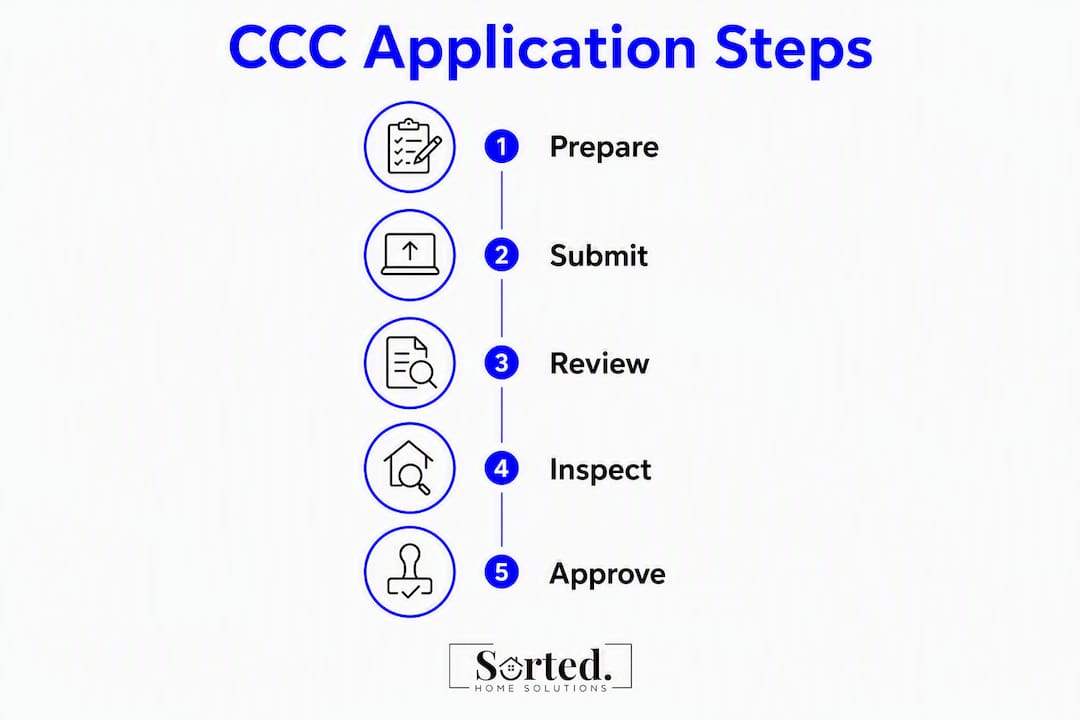
Step-by-step checklist
- Confirm all building work described in the consent is finished.
- Book your final inspection with the BCA before submitting anything.
- Collect Records of Building Work from every Licensed Building Practitioner (LBP) involved.
- Gather energy work certificates for any electrical or gas work.
- Obtain evidence of ownership (certificate of title or equivalent).
- Include producer statements PS1 and PS3 where your project required them.
- Attach a compliance schedule if your building has specified systems (fire alarms, sprinklers, etc.).
- Submit Form 6 to your BCA with all supporting documents attached.
Pro Tip: Collect LBP records and energy certificates during the build, not after. Waiting until the end is the most common reason applications come back incomplete.
Required documents at a glance
| Document | Why it is required |
|---|---|
| Record of Building Work (LBP) | Confirms licensed tradespeople completed restricted building work |
| Energy work certificates | Verifies electrical and gas work meets the Building Code |
| Evidence of ownership | Confirms the applicant is the legal owner |
| Producer statements PS1/PS3 | Design and construction assurance for complex or engineered work |
| Compliance schedule | Required where specified systems are installed |
| B2 Durability form (older builds) | Auckland Council and others request this for work older than five years |
Timing and common refusal causes
The BCA has 20 working days to decide once a complete application is received. That clock pauses the moment a Request for Further Information (RFI) is issued and does not restart until all requested material arrives. Missing LBP records, incomplete inspections, and unpaid council charges are the most frequent triggers. Submit only when your documents are complete.
The practical case for a single point of contact
The owner is legally responsible for applying for a CCC under the Building Act 2004. That said, appointing an agent or contractor to manage the process is both common and practical, and it is worth being deliberate about who that is.
Projects run by a single point of contact are less likely to suffer the documentation gaps that trigger RFIs. When one company coordinates trades, tracks LBP records, arranges inspections, and collates energy certificates throughout the build, the application tends to be complete the first time. That matters because each RFI pauses the statutory clock and adds real time to your project close-out.

Pro Tip: Before signing any home renovation contract, confirm in writing who will apply for the CCC and which documents the contractor will supply. This one clause prevents the most common application delays.
Sortedhomesolutions handles the paperwork so you don't have to
Managing a CCC application means coordinating inspections, chasing LBP records, and submitting the right forms at the right time. Sortedhomesolutions acts as your single point of contact across all trades, from building and plumbing to electrical and plastering, and manages the consent close-out process alongside the physical work.

Before you hire any contractor, ask these three questions:
- Who will apply for the CCC, and will that be confirmed in the contract?
- Who holds the LBP records during the build, and how will they be supplied?
- What fees, if any, apply for consent sign-off and final inspection coordination?
Sortedhomesolutions answers all three upfront. Get a quote or confirm your project scope directly, and check renovation pricing for kitchen and bathroom packages that include full project management.
Useful official sources
The table below lists the primary sources for CCC forms, statutory text, and council guidance.
| Source | What you will find |
|---|---|
| Building Performance — CCC guidance | Statutory requirements, the 24-month rule, and BCA obligations |
| Building Act 2004 — section 95 | The owner's legal obligation to apply |
| Form 6 — CCC application | The official application form |
| Wellington City Council — applying for a CCC | 20-day clock, RFI process, local guidance |
| Auckland Council — CCC applications | Auckland-specific requirements including B2 Durability forms |
| MBIE Building Code compliance | Building Code standards and the BCA's 'satisfied on reasonable grounds' test |
| Completing your project — Building Performance | Post-consent obligations and certificate of acceptance guidance |
- Always check your own territorial authority's website for local fees, forms, and inspection booking processes.
- The 20 working-day clock and RFI rules apply nationally, but council-specific requirements (such as the B2 Durability form) vary.
- For ongoing record-keeping throughout your project, a property maintenance guide can help you organise documentation before you need it.
| Point | Details |
|---|---|
| Legal basis | A CCC is issued under section 95 of the Building Act 2004 by your BCA. |
| Apply promptly | Submit as soon as work is complete; the BCA decides at 24 months if you do not. |
| Complete documents | Missing LBP records or energy certificates trigger RFIs and pause the 20-day clock. |
| Older builds | Work older than several years may require a B2 Durability form from your council. |
| Sortedhomesolutions | Manages consent close-out, trade coordination, and CCC paperwork as a single point of contact. |