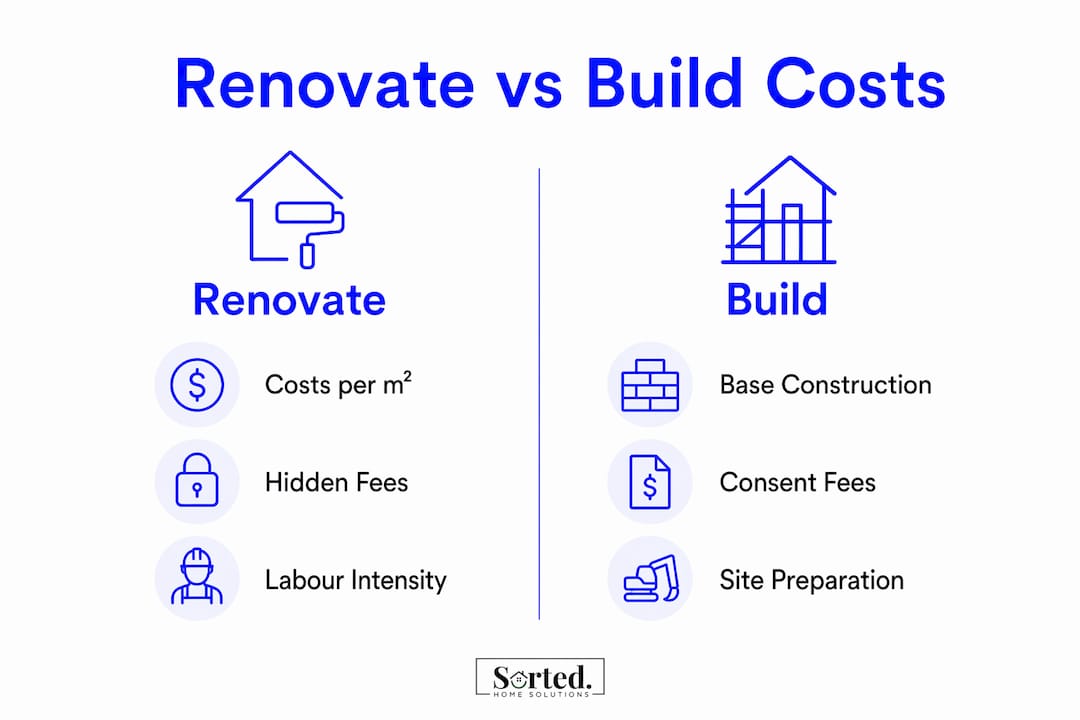
For most Auckland homeowners, building new costs more upfront. A mid-range new build typically costs more per m² than a mid-range renovation, which generally sits below the new build figure. On a 150 m² home, that gap can mean a significant difference in total project cost.
That said, the verdict flips in specific situations:
- Structural or services issues: When foundations, framing, wiring, or plumbing need full replacement, renovation costs approach rebuild territory.
- Heritage or character overlays: Auckland's Special Character Areas under the Unitary Plan can restrict demolition, making renovation the only practical path regardless of cost.
- Difficult sites: Steep sections, poor ground conditions, or contaminated soil add site-work costs that affect new builds far more than renovations.
The practical rule of thumb used across the New Zealand construction industry is that if your renovation quote approaches two-thirds of what a new build on the same site would cost, rebuilding usually delivers better long-term value. That threshold is a starting point, not a hard rule. Consent complexity, timing, and what you want to keep all shift the answer.
Table of Contents
- Which is more expensive, renovate or build? An Auckland comparison
- What does renovation actually cost in Auckland?
- What does building a new home cost in Auckland?
- Hidden costs that change the Auckland calculation
- How to decide: a practical checklist for Auckland homeowners
- How Sortedhomesolutions approaches the renovate vs build decision
- Key takeaways
- The case for a measured, evidence-based approach
- Get a clear picture before you commit: Sortedhomesolutions’ free pre-check
- Useful Auckland and New Zealand sources
Which is more expensive, renovate or build? An Auckland comparison
The table below sets out the key dimensions side by side. Figures reflect Auckland 2026 conditions.
| Dimension | Minor cosmetic renovation | Major whole-house renovation | Knock-down rebuild | New build on vacant lot |
|---|---|---|---|---|
| Estimated total cost | ranges from low to high depending on scope | spans moderate full renovations to high-end projects | can be substantial for knock-down rebuilds | and varies widely for new builds on vacant lots |
| Cost per m² | generally lowest for minor renovations | moderate for major whole-house renovations | higher for knock-down rebuilds | and similar for new builds on vacant lots |
| Typical timeline | varies for cosmetic renovations | ranges months for whole-house renovations | and extends over a year for rebuilds and new construction | |
| Consent complexity | Low (often permitted activity) | Moderate (building consent likely) | High (building + possible resource consent) | High (building consent, possible resource consent) |
| Design/scope flexibility | Low (constrained by existing structure) | Moderate | High | High |
| Resale/long-term value | Moderate uplift | Strong uplift if well-specified | Strong, modern compliance | Strong, modern compliance |
| Common contingency | 10–15% | 15–25% | 15–20% | 10–15% |
| Financing/bridging | Standard mortgage top-up | Construction loan or top-up | Construction loan + possible bridging | Construction loan |
A few points worth noting. Per-m² figures for renovations can be misleading because you are paying for labour inside an existing structure, which is slower and more complex than open-site construction. High-spec renovation work can match or exceed new-build per-m² rates when trades are working around existing walls, services, and finishes.
Pro Tip: To convert a per-m² quote into a realistic all-in Auckland total, add the consent fee estimate from Auckland Council's fee schedule, allow 20–30% on top of the base build cost for site works and external items, and include a contingency of at least 15% for any project involving an existing structure.
What does renovation actually cost in Auckland?
Renovation costs in Auckland vary more than most homeowners expect, and the range is wide for good reason. A cosmetic refresh and a full structural renovation are both called "renovations," but they sit at opposite ends of the cost spectrum.
Typical Auckland renovation cost ranges
| Renovation type | Cost per m² | Typical total (150 m² home) |
|---|---|---|
| Cosmetic/minor work including paint, flooring, and fixtures varies widely in cost depending on project size and scope. | ||
| Mid-range full renovations incur moderate to significant costs depending on extent of work and home size. | ||
| High-end or architectural renovations command higher costs reflecting premium finishes and design complexity. |
For individual rooms, kitchen and bathroom costs are the biggest single line items in most Auckland renovation budgets:
- Mid-range kitchen renovation: $25,000–$60,000, depending on layout changes, cabinetry specification, and whether plumbing moves.
- Primary bathroom renovation: $18,000–$40,000 for a full refit with tiling, new fixtures, and waterproofing.
- Whole-house renovation (150 m²): $280,000–$450,000 for a mid-to-high-spec result, including kitchen, bathrooms, living areas, and services upgrades.
Kitchens and bathrooms are consistently the most expensive rooms to renovate because they combine plumbing, electrical, waterproofing, and cabinetry in a confined space. Structural work and services upgrades come next.
What pushes renovation costs higher
Several factors can add 10–40% to a base renovation quote:
- Structural repairs: Rotted framing, subfloor replacement, or earthquake strengthening can add $30,000–$150,000 to a project.
- Services upgrades: Rewiring a pre-1980s home or replacing galvanised plumbing typically adds $15,000–$40,000.
- Hazardous material removal: Asbestos in textured ceilings or floor tiles, or lead paint, requires licensed removal and adds $5,000–$25,000 depending on extent.
- Matching existing finishes: Blending new work with heritage joinery, weatherboards, or plaster ceilings is labour-intensive and adds cost that does not show up in a standard per-m² rate.
- Consent-triggered upgrades: Once a building consent is lodged, Auckland Council may require the whole building to meet current code for insulation, bracing, or accessibility, which can widen the scope significantly.
A mid-range renovation that starts as a kitchen and bathroom refresh can escalate quickly once a builder opens walls. Getting a structural survey before finalising a budget is the single most effective way to avoid that surprise.
What does building a new home cost in Auckland?
New builds in Auckland sit at the top end of New Zealand's cost range. Mid-range builds in Auckland are frequently cited around NZ$3,200–$4,500+ per m², with high-end and architectural work above that. The national average sits around NZ$3,245 per m², which puts Auckland well above the midpoint.
Auckland new-build cost bands (2026)
| Build specification | Cost per m² | Worked total: 150 m² |
|---|---|---|
| Entry-level/standard | $3,200–$4,500 | $480,000–$675,000 |
| Mid-range | $3,200–$4,500 | $480,000–$675,000 |
| High-end/architectural | above $4,500 | — |
These figures reflect base construction cost. For a realistic all-in Auckland budget, add 20–30% for site works, consents, and external items as per industry guidance; for a 150 m² mid-range build, this brings the total to $480,000–$675,000 before land.
Fixed-price vs cost-plus contracts
Contract type is one of the most consequential decisions in a new build. Fixed-price contracts give you budget certainty and are well-suited to families who need to plan financing precisely. The builder carries the risk of cost increases, but that risk is priced into the contract margin. Cost-plus contracts can be cheaper initially, but they transfer cost risk to you. Overruns of 15–30% are possible on complex or evolving projects without strict oversight. For most Auckland homeowners building a standard residential home, a fixed-price contract is the lower-risk choice.
Hidden costs that change the Auckland calculation
The gap between a quoted price and a final invoice is where most renovation and build budgets come unstuck. Several cost categories are routinely excluded from initial quotes.
Common hidden and ancillary costs
- Geotechnical investigation (geotech): Required for most Auckland sites before consent is granted. Costs $2,000–$8,000 and can reveal ground conditions that require engineered foundations, adding $20,000–$60,000 to a build.
- Engineered foundations: Reactive soils, high water tables, or steep sites in Auckland often require piled or raft foundations rather than standard slabs.
- Retaining walls: Common on Auckland's hilly sections. A single retaining wall can cost $15,000–$60,000 depending on height and material.
- Contaminated material removal: Older Auckland properties may have asbestos-containing materials, lead paint, or contaminated soil from previous land use.
- Temporary accommodation: A full renovation or knock-down rebuild typically means 6–18 months of rent or alternative accommodation, adding $20,000–$50,000+ to the real cost of the project.
- Development contributions: Auckland Council charges development contributions on new dwellings and significant additions. These vary by location and project type.
- Service connection fees: New connections for water, wastewater, and stormwater from Watercare and Auckland Council can add $10,000–$30,000 for a new build.
- Resource consent: If your project triggers a resource consent under the Auckland Unitary Plan (heritage overlay, non-complying activity, or subdivision), add $5,000–$20,000+ in fees and 2–6 months to the timeline.
The 20–30% rule: Industry guidance consistently recommends adding 20–30% to any base build quote to cover site works, consents, and external items. On a $700,000 build, that is $140,000–$210,000 in additional costs that may not appear in the first quote you receive.
Pro Tip: When reviewing any builder or contractor quote, ask specifically what is excluded. Request a written list of exclusions before signing. Key items to confirm in writing: geotech, consent fees, site works, temporary fencing, waste disposal, and connection fees. A quote that omits these is not a fair comparison against one that includes them. Understanding how construction bids work before you review quotes helps you ask the right questions.
How to decide: a practical checklist for Auckland homeowners
The decision between renovating and building new is rarely made on cost alone, but cost is the starting point. Follow these steps in order before committing to either path.
-
Commission a structural survey. Before getting renovation quotes, have a licensed building inspector assess the existing structure. This identifies hidden defects that will affect the renovation scope and cost. Budget $500–$1,500 for a thorough inspection.
-
Get a geotech report. If you are considering a new build or significant addition, a geotechnical investigation tells you what the ground can support and whether engineered foundations are needed. This affects both build cost and consent requirements.
-
Check consent and Unitary Plan obligations. Review your property's zoning and any overlays on the Auckland Unitary Plan. Special Character Area overlays can restrict demolition and limit what a new build can look like. The building consent process at building.govt.nz sets out what triggers a consent and what documentation is required.
-
Get detailed, itemised quotes for both options. A ballpark renovation estimate and a builder's indicative build price are not comparable. Get quotes that include the same scope: consents, site works, professional fees, and a contingency allowance.
-
Convert per-m² to all-in totals. Add site works, consents, professional fees, temporary accommodation, and contingency to both quotes. The per-m² figure is a starting point; the all-in total is what you will actually spend.
-
Apply the 60–70% rule of thumb. If your all-in renovation quote exceeds 60–70% of the all-in new build cost, rebuilding typically delivers better long-term value. The logic: at that cost level, you get a fully code-compliant, modern structure with a new building warranty rather than an upgraded older home.
-
Consider non-financial factors. Heritage value, emotional attachment, neighbourhood character, sustainability, and timing all matter. A renovation that preserves a well-built 1920s bungalow may be the right choice even if the numbers are close.
Worked example: applying the rule of thumb
A homeowner in a mid-Auckland suburb has a 150 m² 1970s home on a flat section. Structural survey reveals the framing is sound but the kitchen, bathrooms, and services need full replacement.
- Detailed renovation quote (all-in): $380,000 (including consents, services upgrades, kitchen, bathrooms, contingency).
- New build quote (all-in): $525,000 (including demolition, consents, site works, 150 m² mid-range build, landscaping, contingency).
- Renovation as a percentage of new build: $380,000 ÷ $525,000 = 72.4%.
At 65.5%, the renovation sits right at the threshold. The deciding factors here are non-financial: the existing framing is sound, the section is flat (no site-work premium), and the homeowner wants to retain the home's character. Renovation wins. If the structural survey had revealed significant framing damage, pushing the renovation quote to $430,000 (74% of the new build cost), the rebuild would be the clearer choice.
Pro Tip: Ask your builder to provide a fixed-price element for the structural and services scope, even if the fit-out is quoted separately. This limits your exposure to the highest-risk cost items and gives you a reliable base for the 60–70% comparison. Staged quotes and fixed-price elements reduce the uncertainty that makes early-stage comparisons unreliable.
How Sortedhomesolutions approaches the renovate vs build decision
Two anonymised Auckland projects illustrate how the decision plays out in practice.
Case study 1: suburban kitchen and extension, West Auckland
A homeowner wanted to modernise a 1980s three-bedroom home, adding an open-plan kitchen and dining extension of approximately 25 m². The existing structure was sound. The project included a new kitchen, bathroom refresh, extension consent, and structural connection to the existing roof line.
- Total budget range: $180,000–$220,000 all-in.
- Timeline: Approximately 5 months from consent lodgement to completion.
- Why renovation made sense: The existing framing and foundations were in good condition. A knock-down rebuild on the same section would have cost $480,000–$675,000 all-in. The renovation delivered the functional outcome at roughly 32–46% of the rebuild cost.
Case study 2: inner-Auckland knock-down rebuild, Grey Lynn
A homeowner purchased an older weatherboard home on a flat 450 m² section. A pre-purchase building inspection revealed extensive subfloor rot, failing services, and non-compliant bracing. A full renovation quote came in at $490,000. A new build quote on the same section came in at $525,000 all-in (including demolition).
- Renovation as a percentage of new build: 93%.
- Decision: Rebuild. At 79% of the new build cost, the renovation delivered an upgraded older home with residual risk; the rebuild delivered a fully compliant, modern home with a new building warranty.
- Timeline: 14 months from consent to completion.
Sortedhomesolutions manages the full project from initial assessment through to completion, handling all trades, consent lodgement, and council liaison under one point of contact. Before-and-after results from completed Auckland projects show typical budget ranges and timelines across kitchen, bathroom, and whole-house scopes. For homeowners at the early decision stage, kitchen and bathroom package pricing is published on the Sortedhomesolutions pricing page.
Key takeaways
For most Auckland homeowners, building new costs more than renovating, but the gap narrows quickly when structural defects, services upgrades, or difficult site conditions are involved.
| Point | Details |
|---|---|
| New builds cost more per m² | Auckland mid-range builds run NZ$3,200–$4,500+ per m²; mid-range renovations typically sit below that figure. |
| The 60–70% rule guides the decision | If your all-in renovation quote exceeds 60–70% of a new build on the same site, rebuilding usually delivers better long-term value. |
| Hidden costs shift the comparison | Add 20–30% to any base build quote for site works, consents, and external items; temporary accommodation adds $20,000–$50,000+ to either path. |
| Consent and Unitary Plan rules matter | Special Character Area overlays can prevent demolition; always check zoning before committing to a rebuild. |
| Sortedhomesolutions manages the whole process | From structural assessment and consent lodgement to trades coordination, Sortedhomesolutions provides one point of contact for Auckland renovation projects. |
The case for a measured, evidence-based approach
Most homeowners arrive at this decision with a strong instinct one way or the other. They have already fallen in love with the idea of a new home, or they are attached to the existing one. The instinct is not wrong, but it tends to get tested hard once the quotes arrive.
What the numbers consistently show is that the cost gap between renovating and building new is real but not fixed. It depends on the condition of the existing structure, the site, the consent pathway, and the specification you are targeting. A renovation that starts as a kitchen refresh can become a whole-house project once a builder opens walls. A new build that looks straightforward on paper can carry $100,000 in site costs that were not in the first estimate.
The homeowners who navigate this well are the ones who invest in early diagnostics: a structural survey, a geotech report, and a consenting check before they commit to a direction. That early spend, typically a few thousand dollars, is the most cost-effective thing you can do. It turns a gut-feel comparison into a defensible decision backed by real numbers.
The 60–70% rule of thumb is useful, but it is only as good as the quotes feeding into it. Comparing a detailed, all-in renovation quote against a builder's indicative new-build price is not a fair test. Both quotes need to include the same scope: consents, site works, professional fees, contingency, and temporary accommodation. Get those numbers right first, then apply the rule.
Get a clear picture before you commit: Sortedhomesolutions’ free pre-check
Deciding between renovating and building is easier when you have real numbers, not estimates based on assumptions. Sortedhomesolutions offers a free pre-check for Auckland homeowners at the early decision stage. The pre-check covers an initial assessment of the existing structure, a review of the proposed scope, and a realistic budget range for the renovation path.

You receive a clear summary of what the renovation would involve, which consent pathway applies, and whether the project scope warrants a more detailed quote. Most pre-checks are completed within a few business days. If the scope is straightforward, a fixed-price package quote follows shortly after. For larger or more complex projects, a detailed quote with itemised trades and consent costs is the next step.
Sortedhomesolutions handles all trades under one team, manages the consent process with Auckland Council, and provides a single point of contact from start to finish. View kitchen and bathroom pricing to see published package rates, or contact the team to arrange your free pre-check.
Useful Auckland and New Zealand sources
The sources below are worth bookmarking if you are working through the renovate vs build decision.
-
building.govt.nz — building consent process: The Ministry of Business, Innovation and Employment's official guide to what triggers a building consent, what documentation is required, and how the process works. Start here before lodging anything with Auckland Council.
-
Auckland Council — resource consent applications: Auckland Council's resource consent portal. Useful for checking recent applications in your area and understanding what the consent process involves for your property type.
-
Auckland Unitary Plan — Special Character Areas Overlay: The operative overlay rules for residential Special Character Areas. If your property is in a character area, this document sets out what demolition and new construction require.
-
Sortedhomesolutions renovation cost calculator: A localised budgeting guide with Auckland cost breakdowns to help you convert per-m² quotes into realistic all-in totals.
-
Sortedhomesolutions kitchen and bathroom cost guide: Detailed cost breakdowns for the two most expensive rooms in any Auckland renovation, with 2026 figures.
Your practical next steps
- Commission a licensed building inspection of the existing structure ($500–$1,500).
- Check your property's zoning and any overlays on the Auckland Unitary Plan viewer.
- Get a geotech report if a new build or significant addition is under consideration ($2,000–$8,000).
- Obtain two detailed, itemised quotes: one for the renovation scope, one for a new build on the same site.
- Contact Sortedhomesolutions for a free pre-check and a realistic renovation budget range before committing to either path.
This article provides general information for Auckland homeowners and does not constitute professional legal, financial, or building advice. Confirm current consent requirements, fees, and cost estimates with Auckland Council, a licensed building professional, or a qualified adviser for your specific project.