
A renovation cost calculator NZ is defined as a budgeting tool that estimates total project expenditure by combining materials, labour, council consent fees, project management charges, and a mandatory contingency buffer. Auckland homeowners face some of the highest renovation costs in the country, making accurate estimates critical before a single tradie sets foot on site. The standard industry term for this process is "cost estimation," and the calculator is the practical tool that makes it accessible to everyday homeowners. Getting your numbers right at the start protects you from the budget blowouts that derail so many New Zealand renovation projects.
What does a renovation cost calculator NZ actually calculate?
A renovation cost calculator works from a straightforward formula: total project cost equals materials plus labour, plus council consent fees, plus project management, plus contingency. Each of those components carries real weight in the final number, and leaving any one out produces a figure that will let you down.
The core cost categories are:
- Materials and labour by trade. NZ trade rates vary significantly across trades and regions. Builders charge $80–$120 per hour, electricians $100–$150 per hour, plumbers $90–$140 per hour, and tile layers $60–$90 per hour. Labour alone can account for more than half of a mid-range renovation budget.
- Council consent fees. Building consents are required for structural works, plumbing changes, and decks over 1.5 metres. Consent fees typically sit between $1,500 and $5,000 depending on the scope of work and your local council.
- Project management fees. Effective project management in New Zealand typically costs 5–10% of the total build cost. This covers scheduling, supplier coordination, and quality oversight. Skipping a project manager often costs more in delays and errors than the fee itself.
- Contingency buffer. New Zealand renovation projects should reserve 15–20% contingency on top of the base estimate. Older homes in particular hide structural surprises behind walls and under floors.
Pro Tip: Always add your contingency after you have totalled materials, labour, consents, and project management. Applying it to a partial figure leaves you short when the unexpected arrives.
Kitchen cabinetry alone accounts for 30–40% of kitchen renovation budgets. That single fact explains why two kitchens with identical floor plans can produce wildly different quotes. Material quality is the biggest lever you control.
How do regional factors affect renovation cost estimates in New Zealand?
Regional location is one of the most significant variables in any home renovation budget estimator. Auckland and Wellington consistently produce higher quotes than provincial centres, and the gap is not trivial.
"Accurate renovation estimates depend heavily on incorporating regional labour rates and compliance costs specific to the project's location. A calculator that uses national averages will underestimate Auckland costs and may overestimate costs in smaller towns."
Auckland and Wellington labour and compliance costs sit above the national average due to higher tradie demand, greater council compliance requirements, and increased material freight costs. A bathroom renovation priced at $25,000 in Hamilton could easily reach $32,000 or more in Auckland for the same scope of work. That difference is not a pricing anomaly. It reflects real market conditions.
Using a calculator that allows you to input your specific region produces a far more reliable estimate than one that applies a single national rate. If you are planning a renovation in Auckland, verify the labour rates your calculator uses against current local quotes. Sortedhomesolutions operates across Auckland and can provide Auckland-specific pricing that reflects what trades actually charge in your suburb right now.

Regional compliance requirements also vary. Some Auckland councils apply additional requirements for heritage zones, flood-prone areas, or specific zoning overlays. A calculator cannot capture every local nuance, which is why pairing your estimate with a conversation with a local tradie or renovation company is the most reliable approach.
How to use a renovation cost calculator effectively
Getting useful output from a renovation budgeting tool depends on the quality of the inputs you provide. Garbage in, garbage out applies here as much as anywhere.
Follow these steps to get a reliable cost estimate for home renovations:
- Choose your budget tier first. Most calculators offer basic, mid-range, and high-end tiers. Basic covers functional finishes with entry-level fixtures. Mid-range uses quality materials with standard trade finishes. High-end includes premium cabinetry, custom joinery, and top-tier appliances. Selecting realistic budget tiers early and factoring in project complexity reduces the likelihood of unexpected expenses during the build.
- List every component of the renovation. Do not estimate a kitchen and forget the splashback, the rangehood ducting, or the electrical upgrade for new appliances. Each omission creates a gap between your calculator output and your final invoice.
- Input the correct region. As covered above, Auckland rates differ from national averages. Use your actual location, not a default setting.
- Apply the right contingency percentage. Use 15% for newer homes with straightforward projects. Use 20% for homes built before 1980 or for projects involving structural changes, plumbing reroutes, or asbestos risk.
- Validate with actual quotes. A calculator gives you a planning figure. Three quotes from licensed tradespeople give you a market figure. Use both together to set your final budget.
Pro Tip: Check whether your renovation requires a building consent before you finalise your budget. Consent fees of $1,500–$5,000 are non-negotiable once you cross the threshold for structural or plumbing work, and missing this line item is one of the most common causes of budget overruns.
Homeowners commonly underestimate the impact of material quality and ignore contingency entirely. Both mistakes produce the same result: a project that runs out of money before it runs out of scope.
Typical renovation costs using NZ calculators: 2026 examples
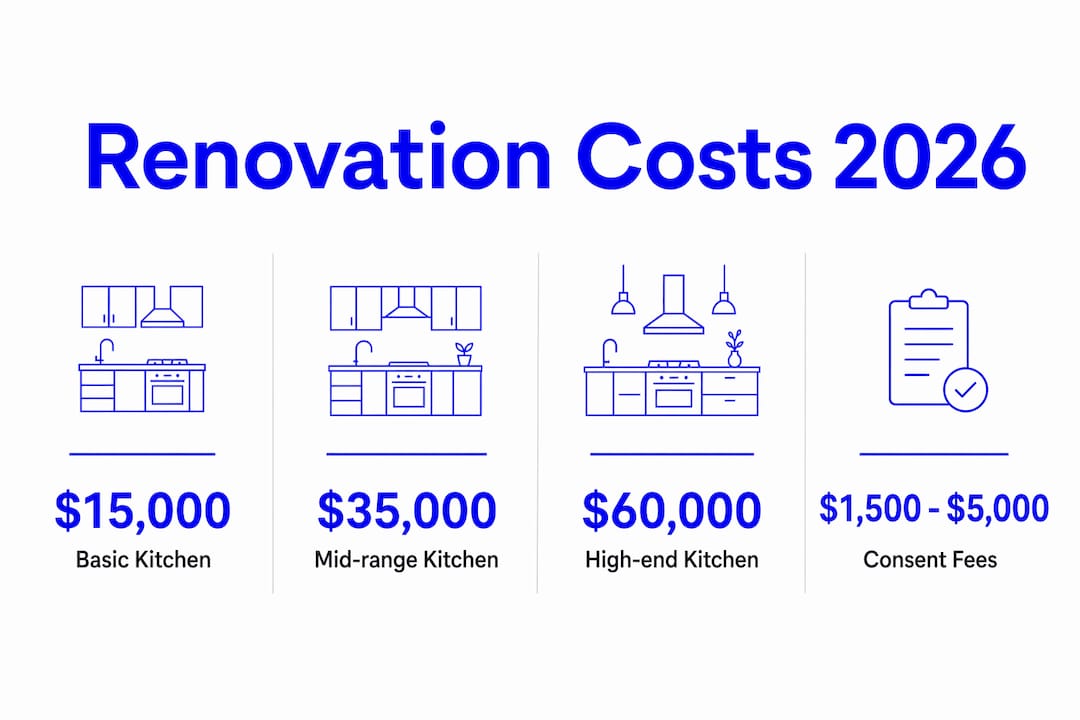
The table below shows sample cost estimates for three common renovation types across three budget tiers, based on current New Zealand industry data. These figures reflect typical NZ renovation costs and include labour and materials but exclude consent fees and contingency.
| Renovation type | Basic | Mid-range | High-end |
|---|---|---|---|
| Kitchen | $15,000 | $35,000 | $60,000 |
| Bathroom | $10,000 | $25,000 | $45,000 |
| Interior painting (full house) | $3,000 | $8,000 | $15,000 |
To build a realistic total, add consent fees where applicable ($1,500–$5,000), project management at 5–10% of the base cost, and a contingency of 15–20%. A mid-range kitchen renovation at $35,000 with a project manager at 7% and a 15% contingency produces a realistic budget of approximately $43,000 before consent fees. That is a significant difference from the base figure, and it is the figure you should plan around.
For bathroom renovations, you can read more about typical bathroom costs and what drives variation between projects. The gap between a $10,000 and a $45,000 bathroom comes down to fixture quality, tile selection, whether the layout changes, and whether plumbing rerouting triggers a consent requirement.
Interior painting is the most predictable renovation category because it rarely involves consents or structural surprises. Even so, the difference between a $3,000 and a $15,000 result reflects paint quality, surface preparation, the number of rooms, and ceiling height.
Key takeaways
A renovation cost calculator NZ produces reliable estimates only when you include all cost components: materials, labour, consents, project management, and a 15–20% contingency buffer.
| Point | Details |
|---|---|
| Use the full cost formula | Include materials, labour, consents, project management, and contingency in every estimate. |
| Apply regional rates | Auckland labour and compliance costs sit above national averages; use location-specific inputs. |
| Set your budget tier early | Choosing basic, mid-range, or high-end upfront reduces the risk of unexpected cost increases. |
| Contingency is non-negotiable | Reserve 15% for newer homes and 20% for older properties or complex structural work. |
| Validate with real quotes | Calculator outputs are planning figures; three trade quotes confirm what the market actually charges. |
Why I trust the calculator but never rely on it alone
I have worked through enough Auckland renovation projects to know that a calculator is a starting point, not a finish line. The numbers it produces are only as good as the inputs you give it, and most homeowners underestimate at least one major cost category on their first attempt.
The contingency rule is the one I see ignored most often. Homeowners look at the 15–20% figure and treat it as optional padding. It is not. I have seen a straightforward bathroom renovation in a 1960s Auckland bungalow uncover rotted subfloor framing, asbestos-containing vinyl, and a plumbing stack that needed full replacement. None of that appeared in the original scope. The contingency covered it. Without it, the project would have stalled.
My honest advice: run the calculator, then book a site visit with a local renovation company before you commit to a budget. A calculator cannot see your specific home. A tradie can. The combination of a well-structured estimate and a professional site assessment is the most reliable way to set a budget you can actually stick to.
Renovation planning made clearer with Sortedhomesolutions
Sortedhomesolutions handles Auckland home renovations from the first estimate through to the final inspection, with all trades under one team.

If you are ready to move from calculator estimates to real project numbers, Sortedhomesolutions offers transparent pricing and direct consultation for kitchens, bathrooms, and general home repairs across Auckland. You can review kitchen and bathroom pricing to see what current projects cost in your area, or get in touch directly to discuss your specific renovation scope. The team manages everything from consent applications to trade scheduling, so you are not left coordinating multiple contractors on your own.
FAQ
What does a renovation cost calculator NZ include?
A renovation cost calculator NZ includes materials, labour, council consent fees, project management charges, and a contingency buffer of 15–20%. Together, these components produce a total project estimate rather than just a base build cost.
How much does a kitchen renovation cost in New Zealand?
Kitchen renovation costs in New Zealand range from $15,000 for a basic fit-out to $60,000 for a high-end result, before consent fees and contingency. Cabinetry accounts for 30–40% of the total kitchen budget and is the single biggest cost driver.
Do I need a building consent for my renovation?
Building consents are required for structural works, plumbing changes, and decks over 1.5 metres. Consent fees range from $1,500 to $5,000 and must be included in your renovation budget.
Why are Auckland renovation costs higher than the rest of New Zealand?
Auckland renovation costs are higher due to greater tradie demand, elevated compliance requirements, and increased material costs. A project priced at $25,000 in a provincial centre can cost $30,000 or more in Auckland for the same scope.
How do I avoid a renovation budget blowout?
Apply a 15–20% contingency buffer, include all cost components in your estimate, and validate your calculator output with at least three quotes from licensed tradespeople. Homeowners who skip contingency and underestimate material quality are the most likely to run over budget.
— Rudi